Bolt Size Chart and Bolt Size Finder
Choose inch or metric to see every bolt size with its thread, head and wrench dimensions, or measure a bolt to identify its size.
Popular tools
- Truss CalculatorPick a truss type, span, height and panel loads to get the force in every member, tension or compression, drawn on the truss.
- Garage Door Spring Calculator (Torsion Spring)Work out the torque per turn of a torsion spring and compare it with what your door's weight, height and drum size need.
- Beam Load CalculatorPick a beam section, span and supports, then enter the allowable bending stress to find the largest load it can carry and what governs.
This Bolt Size Chart is a free tool that looks up bolt sizes and shows the specifications for each one. It runs in your browser, needs no sign-up, and works on a phone.
You can choose one of four series: inch coarse (UNC), inch fine (UNF), metric coarse (ISO), or metric fine (ISO), and see every size in that series in a table. You can also work backwards. Enter a measured outside diameter and thread count or pitch, and the tool lists the closest standard sizes. For any chosen bolt, it shows the major diameter, thread pitch, tensile stress area, wrench size, tap drill size, and proof load for an SAE grade or ISO property class. Results update as you type.
How to use the Bolt Size Chart
- Choose a series: Inch coarse (UNC), Inch fine (UNF), Metric coarse (ISO), or Metric fine (ISO).
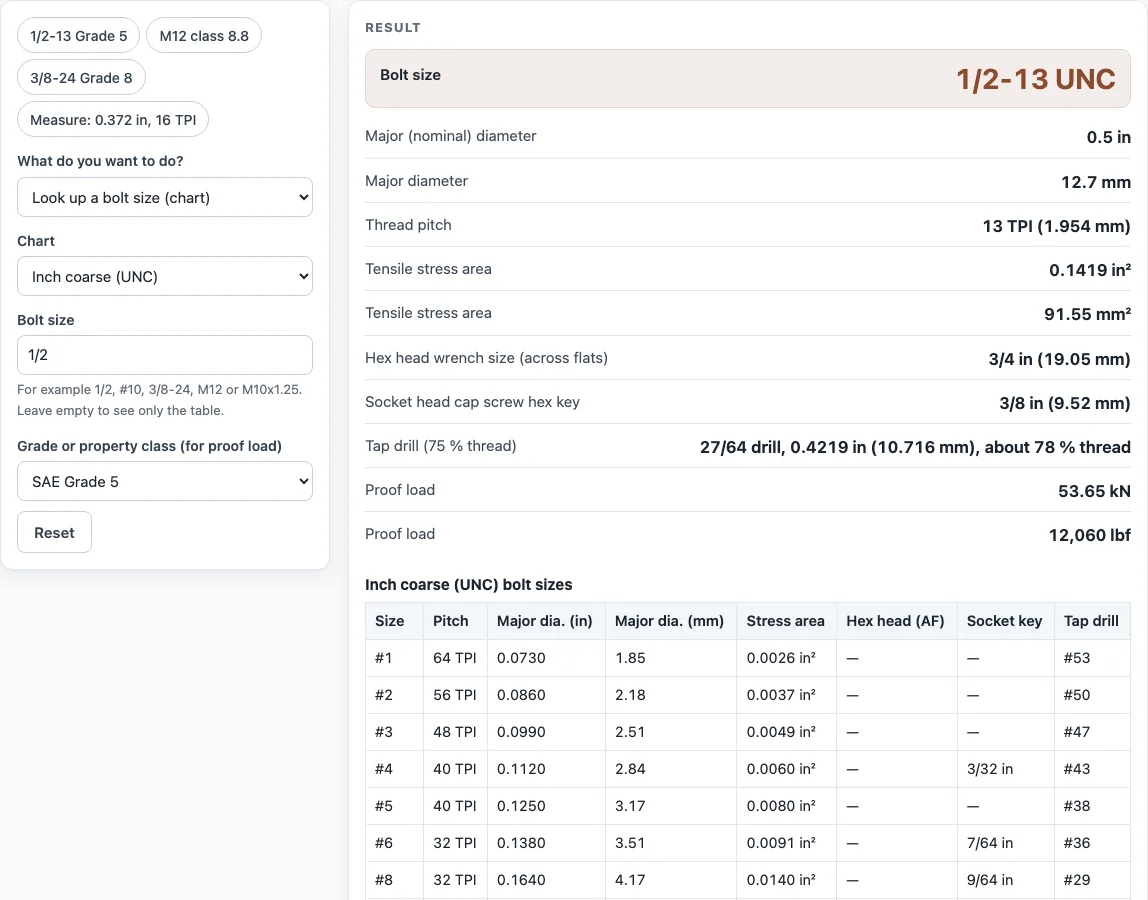
- To look up a size, pick it from the list. The result shows the bolt size, major diameter in inches and mm, thread pitch, tensile stress area, hex head wrench size, socket head cap screw hex key, tap drill for 75 % thread, and proof load.
- Select an SAE grade (2, 5, or 8) for inch bolts, or an ISO property class (4.6, 8.8, 10.9, or 12.9) for metric bolts, to get the proof load.
- Read the chart table to see every size in the series with the same columns.
- To identify a bolt you already have, switch to identify mode. Measure the outside diameter across the threads with a caliper, then count the threads per inch or read the pitch in mm with a thread gauge. Enter both values, and the tool lists the closest standard sizes and the difference.
- Check any warning shown. Warnings appear for sizes outside the standard lists, SAE grade size ranges, sizes with no listed hex head width, and measured bolts that are far from any standard size.
Copy result copies the result lines with a link. Copy link copies the page address, which stores every input, so opening it later restores the same calculation. Print / save as PDF prints the inputs, results, calculation steps, and the date.
How do you read a bolt size?
A bolt size has two parts: the nominal diameter and the thread. The diameter is the largest outside width of the bolt across its threads, and the thread tells you how many threads fit per inch (for inch bolts) or how far apart they are (for metric bolts). For example, 1/2-13 means a bolt 1/2 inch in diameter with 13 threads per inch.
Inch bolts come in coarse (UNC) and fine (UNF) threads. The same 1/2 inch diameter can be made in both, with different thread counts, so the thread count has to match the nut or tapped hole. Fine threads have more threads per inch than coarse threads of the same diameter.
What does M12 x 1.75 mean?
M12 x 1.75 means a metric bolt with a nominal diameter of 12 mm and a pitch of 1.75 mm. Pitch is the distance from one thread crest to the next, measured in millimetres. It plays the same role as threads per inch in inch bolts.
When a metric size is written without a pitch, such as M12, the standard coarse pitch is meant. For M12 that is 1.75 mm. A fine thread of the same diameter uses a smaller pitch and is written with the pitch shown, such as M12 x 1.25. Always confirm the pitch when you order or replace a bolt, because the same diameter with a different pitch will not fit the same nut.
Bolt size guide: bolt sizes explained and a bolt measurement guide
This bolt size guide reads the same way for every row of the chart.
Metric bolt size explained
An M8 bolt (M8 × 1.25 coarse) has a diameter of 8 mm measured across the threads, so the diameter of an M8 screw is 8 mm, not the size of its head; its specs in the chart are a 13 mm hex head (ISO 4014/4017), a 6 mm hex key for the socket head cap screw, a 36.6 mm² tensile stress area and a 6.8 mm tap drill. Metric bolt sizes are named by the M number (diameter in mm) and the pitch; inch bolts by the fraction or number size and threads per inch.
Bolt dimensions explained
Bolt dimensions such as length are measured from under the head to the tip for hex bolts and are chosen separately from the size.
Sources
Checked October 2026:
- Wikipedia, Unified Thread Standard for UNC/UNF threads per inch and number-size diameters (0.060 + 0.013 × N in)
- Wikipedia, ISO metric screw thread for ISO 261/262 coarse and fine pitches
- Tensile stress area At = 0.7854 (d − 0.9743/n)² (inch) and As = 0.7854 (d − 0.9382 P)² (metric), as in ASME B1.1, ISO 898-1 and Machinery’s Handbook
- SAE J429 grades 2, 5 and 8 (Baco Enterprises table): proof and minimum tensile strength by size range
- ISO 898-1 property classes (TR Fastenings): proof stress and minimum tensile strength of classes 4.6, 8.8, 10.9 and 12.9
- Hex cap screw dimensions to ASME B18.2.1 (AFT Fasteners) for inch widths across flats
- DIN EN ISO 4017 and DIN 933 tables (fasten.it) for metric widths across flats
- Eugene Fastener socket screw hex key chart (ASME B18.3 inch) and DIN EN ISO 4762 table (fasten.it) for socket head keys
- Wikipedia, Drill bit sizes for number and letter drill diameters
- Tap drill at 75 % thread = major diameter − 1.299 × pitch × 0.75 (the percentage-of-thread formula in Machinery’s Handbook)
For estimation; verify critical designs against the applicable standard.
Worked examples
| Input | Result |
|---|---|
| 1/2 in the Inch coarse (UNC) chart, SAE Grade 5 | 1/2-13 UNC: stress area 0.1419 in² (91.55 mm²), proof load 12,060 lbf (53.65 kN) |
| M12 in the Metric coarse (ISO) chart, ISO class 8.8 | M12×1.75: stress area 0.1306 in² (84.27 mm²), proof load 10,990 lbf (48.87 kN) |
| #10 in the Inch fine (UNF) chart, SAE Grade 2 | #10-32 UNF: stress area 0.01999 in² (12.9 mm²), proof load 1,100 lbf (4.892 kN) |
| Outside diameter 0.372 in, 16 TPI | 3/8-16 UNC; measured minus nominal −0.076 mm (−0.0030 in) |
| Outside diameter 9.85 mm, 1.5 mm | M10×1.5; measured minus nominal −0.150 mm (−0.0059 in) |
Calculated by the tool above with these values.
Frequently asked questions
How do I measure a bolt size?
Measure the outside diameter across the threads with a caliper, and count the threads per inch or read the pitch with a thread gauge. Enter those numbers in identify mode. A worn bolt measures slightly under its nominal size. For example, 0.372 in with 16 TPI identifies as 3/8-16 UNC.
What size wrench fits a 1/2 inch bolt?
A hex head 1/2 inch bolt takes a 3/4 inch wrench across the flats, based on the ASME B18.2.1 sizes. For metric bolts, M12 uses an 18 mm wrench under ISO 4014 and 4017, while older DIN 931 and 933 bolts use 19 mm. The result shows the hex key size for socket head cap screws.
What is the difference between UNC and UNF?
UNC (Unified National Coarse) and UNF (Unified National Fine) are both inch thread standards. UNC has fewer threads per inch, and UNF has more, for the same nominal diameter. Examples are 1/2-13 UNC and #10-32 UNF. Fine threads are often chosen where the wall is thin or where a finer adjustment is needed.
What is the tensile stress area of a bolt?
The tensile stress area is the effective area that resists tensile load, taking the thread into account. For inch bolts, At = 0.7854 (d − 0.9743/n)², where n is threads per inch. For metric bolts, As = 0.7854 (d − 0.9382P)², where P is pitch in mm. For example, 1/2-13 has 0.1419 in², and M12 x 1.75 has 84.27 mm².
Can I print the bolt size chart?
Yes. Print / save as PDF prints the inputs, results, calculation steps, and the date. Copy link keeps the same series and inputs, so you can reopen the same chart later. The tool is free and nothing is uploaded.
Related tools
- Bolt head size chart: Use it when you need the wrench or hex head size for a bolt head.
- Bolt torque calculator: Use it to estimate the tightening torque for a bolt.
- Bolt shear strength calculator: Use it to check how much sideways load a bolt can carry.
- Stress calculator: Use it to work out the stress in a part under a given load.
- Factor of safety calculator: Use it to compare a design load against the strength of a bolt or part.
- All calculators: Use it to browse every calculator on the site.