Blank Size Calculator (Deep Drawing)
Enter the cup diameter and height, with a corner radius or flange if it has one, to get the blank diameter and the draw ratio.
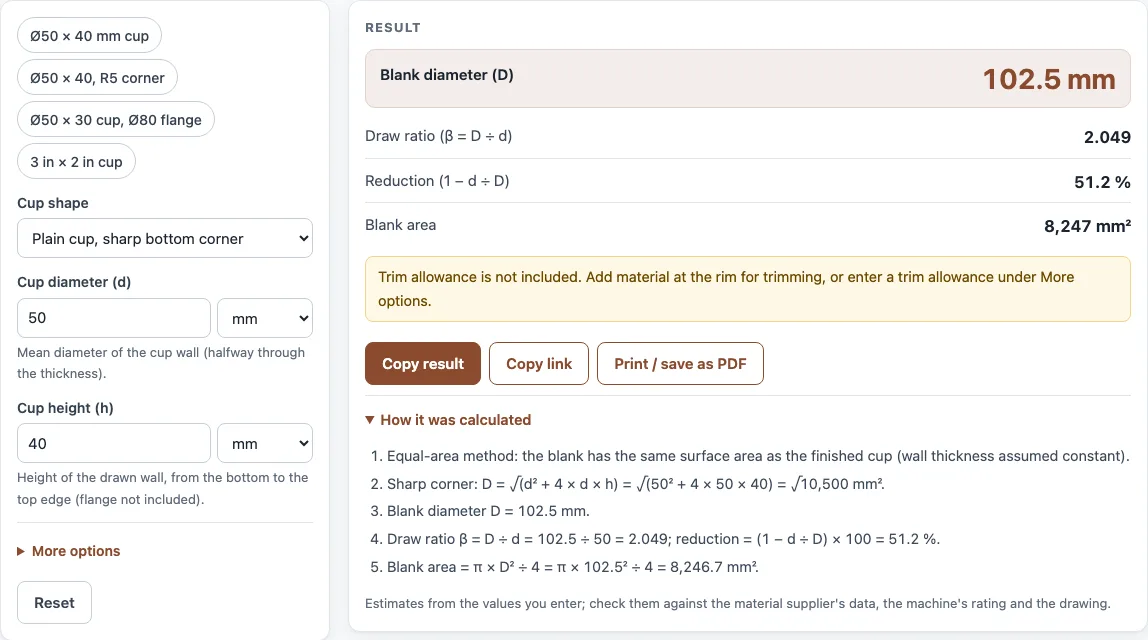
How to use the Blank size calculator
- Enter the cup diameter d in the units you work in. The examples use mm and inches.
- Enter the cup height h.
- For a rounded bottom corner, enter the corner radius r. For a flanged cup, enter the flange diameter df. A plain cup with a sharp bottom corner needs neither.
- Read the blank diameter, draw ratio, reduction and blank area in the results.
- If you need trim, open More options and enter a trim allowance per side. The blank diameter with trim allowance then appears in the results.
- Open How it was calculated to see the formula and each step worked out with your numbers.
Copy result copies the result lines with a link. Copy link copies the page address, which stores every input in the address (?s=…), so opening it later restores the same calculation. Print / save as PDF prints the inputs, results, calculation steps and the date.
Use the presets to compare the three cup shapes with real numbers: a Ø50 × 40 mm cup, the same cup with an R5 corner, a Ø50 × 30 mm cup with an 80 mm flange, and a 3 in × 2 in cup. The steps under the result show the formula for the shape you picked with your numbers in it.
How do you calculate blank size for deep drawing?
The blank is sized so that its area equals the surface area of the finished cup, assuming the sheet thickness stays constant. The blank is a circle, and the cup is a base plus a side wall, so you set the blank’s circle area equal to those two areas and solve for the diameter.
For a plain cup, the base area is π d²/4 and the side wall area is π d h. Setting π D²/4 equal to their sum gives D² = d² + 4dh. Square the cup diameter, add four times d times h, and take the square root. For a Ø50 × 40 mm cup, that is 2500 + 8000 = 10500, and √10500 ≈ 102.5 mm.
If the sheet is thick, use the mean diameter of the cup wall, halfway between the inside and outside diameter, as d.
What is the blank diameter formula for a cup?
For a plain cup with a sharp bottom corner, the formula is D = √(d² + 4dh). Here d is the cup diameter and h is the height. For a cup with a bottom corner radius r, the formula is D = √(d² + 4dh − 1.72dr − 0.56r²). For a flanged cup with a sharp corner, the formula is D = √(df² + 4dh), where df is the flange diameter.
The calculator uses these three forms, and each step appears under How it was calculated.
What is the draw ratio?
The draw ratio β is the blank diameter divided by the cup diameter: β = D ÷ d. For the Ø50 × 40 mm cup, β = 102.5 ÷ 50 = 2.05. The reduction is (1 − d ÷ D) × 100 %, which gives about 51.2 % for this cup.
The draw ratio shows how much the sheet must be drawn in one operation. Every material and tooling setup has a limit. If β is above that limit, the cup needs more than one drawing operation. Check the limit for your material and tooling before you plan a single draw.
How do corner radius and flange change the blank size?
A bottom corner radius reduces the blank size. The −1.72dr and −0.56r² terms take area away from the sharp-corner case, so the blank gets smaller. For the same Ø50 × 40 mm cup with an R5 corner, the blank is 100.3 mm instead of 102.5 mm, and the draw ratio is 2.01.
A flange increases the blank size, because the flange adds material outside the cup wall. For a Ø50 × 30 mm cup with an 80 mm flange, the blank is 111.4 mm. The draw ratio uses the cup diameter d, not the flange diameter, so it is 111.4 ÷ 50 = 2.23.
How much trim allowance should I add?
The calculator adds no trim allowance unless you enter one, and the tool warns you when none is included. The right amount depends on your trimming method and your shop’s standards, so check your process specifications rather than relying on a general figure.
Enter the allowance per side under More options. Because it is added on both sides, the diameter grows by twice the value. For example, a 102.5 mm blank with 3 mm per side becomes 102.5 + 2 × 3 = 108.5 mm.
Sources
Checked October 2026:
- Equal-surface-area blank formulas for drawn cylindrical shells (Machinery’s Handbook); the −1.72 d r − 0.56 r² corner term matches the exact area of a quarter-torus corner (8 − 2π = 1.717, 4π − 12 = 0.566)
For estimation; verify critical designs against the applicable standard.
Worked examples
| Input | Result |
|---|---|
| cup d = 50 mm, h = 40 mm | blank 102.5 mm, draw ratio 2.05 |
| cup d = 50 mm, h = 40 mm, r = 5 mm | blank 100.3 mm, draw ratio 2.01 |
| cup d = 50 mm, h = 30 mm, flange 80 mm | blank 111.4 mm, draw ratio 2.23 |
| cup d = 3 in, h = 2 in | blank 5.745 in, draw ratio 1.91 |
| cup d = 4 in, h = 3 in, r = 0.25 in | blank 7.89 in, draw ratio 1.97 |
Calculated by the tool above with these values.
Frequently asked questions
Can I use inches instead of millimetres?
Yes. The examples include a 3 in × 2 in cup, which gives a blank of 5.745 in and a draw ratio of 1.91. Use the same unit for every input.
What should I do if my sheet is thick?
Use the mean diameter of the cup wall for d, which is halfway between the inside and outside diameter. This keeps the calculation closer to the real wall when the sheet is thick.
Can I use the results in commercial work?
Yes. The results may be used in commercial work, such as quotes, calculations for customers, shop paperwork and reports, without attribution.
How do I save a calculation to come back to later?
Use Copy link to copy the page address. It stores every input, so opening the link later restores the same calculation. To keep a printed record, use Print / save as PDF, which includes the inputs, results, steps and date.
Does the calculator include the flange of a flanged cup in the draw ratio?
No. The draw ratio uses the cup diameter d: β = D ÷ d. The flange only makes the blank larger.
Can I use the blank size calculator for sheet metal parts other than cups?
It covers round drawn cups only: plain, with a corner radius, or with a flange.
Related tools
- Press brake tonnage calculator: use it to estimate the force needed for bending sheet on a press brake.
- Punching force calculator: use it to estimate the force needed to punch holes in sheet material.
- Coil length calculator: use it to work out how much coil or strip length you need for a job.
- Pipe bending calculator: use it when you are working out bends in pipe rather than sheet.
- All calculators: use it to browse every calculator on the site.