Bolt Grade Chart
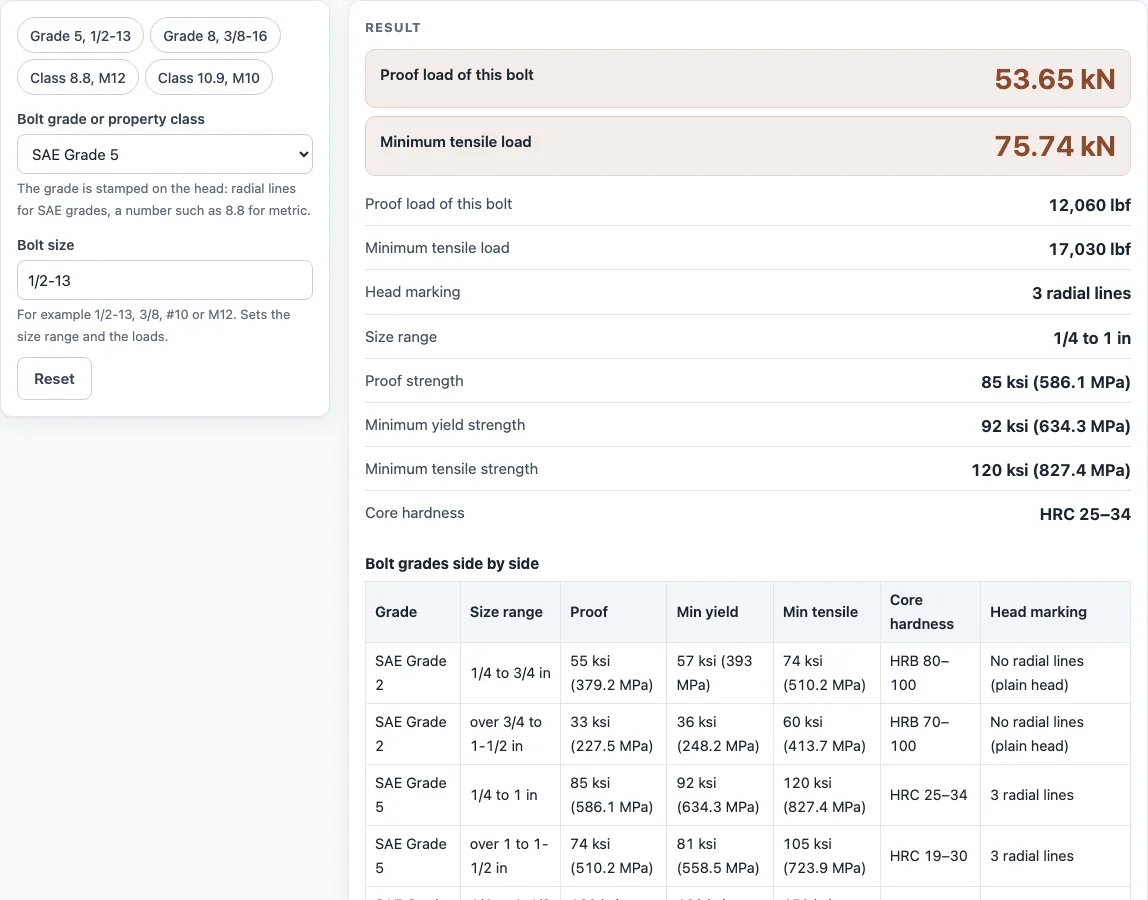
Pick a grade and a bolt size to see its head marking, strengths, hardness and the proof and tensile load that bolt can carry.
This bolt grade chart shows what a bolt grade means. Choose an SAE grade (2, 5 or 8) or a metric property class (4.6, 8.8, 10.9 or 12.9) and a bolt size such as 1/2-13 or M12. You get the head marking to look for, the proof, yield and tensile strength in ksi and MPa, the core hardness, and the proof and tensile load of that exact bolt in kN and pounds-force. A table underneath compares every grade and size range side by side.
It is for anyone who has to identify a bolt from its head, choose a grade for a joint, or check what load a bolt can take before it is used with a torque value or a shear check. It runs in your browser with no sign-up.
How to use the bolt grade chart
- Read the markings on the bolt head. Three radial lines mean SAE Grade 5, six lines mean Grade 8, and a plain head is usually Grade 2. A metric bolt has the class stamped on it, such as 8.8 or 10.9.
- Choose that grade or class in the first list.
- Type the bolt size in the second box: 1/2-13, 3/8-16, #10, M10 or M12. A bare diameter such as 1/2 or M12 picks the coarse thread.
- Read the proof load and the minimum tensile load of that bolt, then the head marking, size range, proof, yield and tensile strengths and core hardness below them.
- Use the table to compare grades. Some grades have two rows because the strength drops for larger diameters.
The preset chips load common grade and size pairs. Copy link keeps your choice in the address, and Print / save as PDF prints the result, the steps and the table with the date. Open How it was calculated to see how the load comes from strength times stress area. If the grade does not suit the size you typed, for example an SAE grade on a metric bolt or a size outside 1/4 to 1-1/2 inch, the tool shows a warning above the steps instead of hiding the problem. Nothing you type is uploaded.
What do bolt grades mean?
A grade is a short code for a bolt’s strength and material. In the inch system, SAE J429 defines grades 2, 5 and 8: a higher number means a stronger, heat-treated steel. In the metric system, ISO 898-1 uses property classes such as 8.8. The first number is about one hundredth of the minimum tensile strength in MPa (8.8 is 800 MPa), and the second shows how the yield strength relates to it (0.8 × 800 = 640 MPa).
How can I tell a Grade 5 from a Grade 8 bolt?
Look at the head. SAE Grade 5 bolts have three radial lines and Grade 8 bolts have six; a plain head with no lines is usually Grade 2, and the manufacturer’s mark may also be on the head. Count the lines and add 2 to get the grade. A plain head does not prove Grade 2, so do not assume an unmarked bolt meets a higher grade.
What is the difference between proof strength, yield strength and tensile strength?
Proof strength is the stress the bolt can carry without any permanent stretch; it is the basis for preload. Yield strength is where permanent stretch starts, and tensile strength is the stress at which the bolt breaks. For a Grade 5 bolt up to 1 inch the table gives 85, 92 and 120 ksi. The proof load of a bolt is the proof strength times its tensile stress area, which the page shows.
What is a metric 8.8 bolt equal to in SAE grades?
By strength, class 8.8 sits between SAE Grade 5 and Grade 8: 800 MPa minimum tensile is 116 ksi, close to Grade 5’s 120 ksi, and class 10.9 at 1040 MPa (151 ksi) is close to Grade 8’s 150 ksi. They are not the same standard, so a swap should be checked against the joint design and thread size.
How is the proof load of a bolt worked out?
Proof load = proof strength × tensile stress area. The tensile stress area comes from the thread: 0.7854 × (d − 0.9743 ÷ n)² for inch threads and 0.7854 × (d − 0.9382 × P)² for metric threads. A 1/2-13 Grade 5 bolt has a stress area of 0.1419 in² and a proof load of 85 ksi × 0.1419 in² = 12,060 lbf.
Sources
- SAE J429 specification table (Baco Enterprises): proof load, minimum yield and tensile strength and core hardness of grades 1, 2, 5 and 8. Checked October 2026.
- Screws and bolts: mechanical properties (TR Fastenings): ISO 898-1 classes 4.6, 8.8, 10.9 and 12.9, with proof stress, yield, tensile and hardness.
- Fastener head markings decoded (Portland Bolt): three radial lines for Grade 5, six for Grade 8.
- Stress area formulas from ASME B1.1 and ISO 898-1. The chart covers the most common grades only; it does not replace the standard.
Worked examples
| Input | Result |
|---|---|
| SAE Grade 5, 1/2-13 | proof load 53.65 kN (12,060 lbf), tensile 75.74 kN (17,030 lbf) |
| SAE Grade 8, 3/8-16 | proof load 41.36 kN (9,299 lbf), tensile 51.7 kN (11,620 lbf) |
| Metric class 8.8, M12 | proof load 48.87 kN (10,990 lbf), tensile 67.41 kN (15,160 lbf) |
| Metric class 10.9, M10 | proof load 48.13 kN (10,820 lbf), tensile 60.31 kN (13,560 lbf) |
| SAE Grade 2, 1/4-20 | proof load 7.785 kN (1,750 lbf), tensile 10.47 kN (2,355 lbf) |
Calculated by the tool above with these values.
Frequently asked questions
Is a Grade 8 bolt always stronger than a Grade 5?
Yes, at the same size: 150 ksi minimum tensile against 120 ksi. But a stronger bolt is harder and less ductile, so it is not always the better choice. Check the joint design before you swap grades.
Can I use a metric class with an inch bolt size on this page?
You can, but the page warns you. Inch bolts are normally made to SAE J429 and metric bolts to ISO 898-1, so a mixed pair is unusual.
Why does the 8.8 class have two rows?
ISO 898-1 gives slightly higher values for diameters over 16 mm (830 MPa minimum tensile instead of 800 MPa), and different hardness limits. The page picks the row that matches the bolt size you type.
What if my bolt has no markings?
An unmarked bolt cannot be identified by its head. Plain heads are often Grade 2 or a low-strength grade, but you cannot count on it. Use a bolt of known grade where strength matters.
Does the proof load include a safety factor?
No. Proof load is the stress the bolt withstands without permanent stretch. Joints are normally designed to use 75 % or less of it as preload. The bolt torque calculator uses this same proof load to set the tightening torque, and the factor of safety calculator helps with the margin.
Related tools
- Bolt torque calculator: use it to get the tightening torque for a grade and size.
- Bolt shear strength calculator: use it to check how much shear load a bolt takes.
- Bolt size chart: use it to look up thread sizes, stress areas and tap drills.
- Bolt head and wrench size chart: use it to find the wrench size for a bolt.
- Factor of safety calculator: use it to compare an allowed load with an applied load.
- All fabrication calculators: use it to browse every calculator on the site.