Bolt Shear Strength Calculator
Get the shear load a bolted joint carries from the bolt size, grade, number of bolts and shear planes, with an optional factor of safety.
The Bolt Shear Strength Calculator estimates how much shear load a group of bolts can carry before they are cut, and it shows the allowable load after a factor of safety. It is free, needs no sign-up, and runs in your browser, so it also works on a phone.
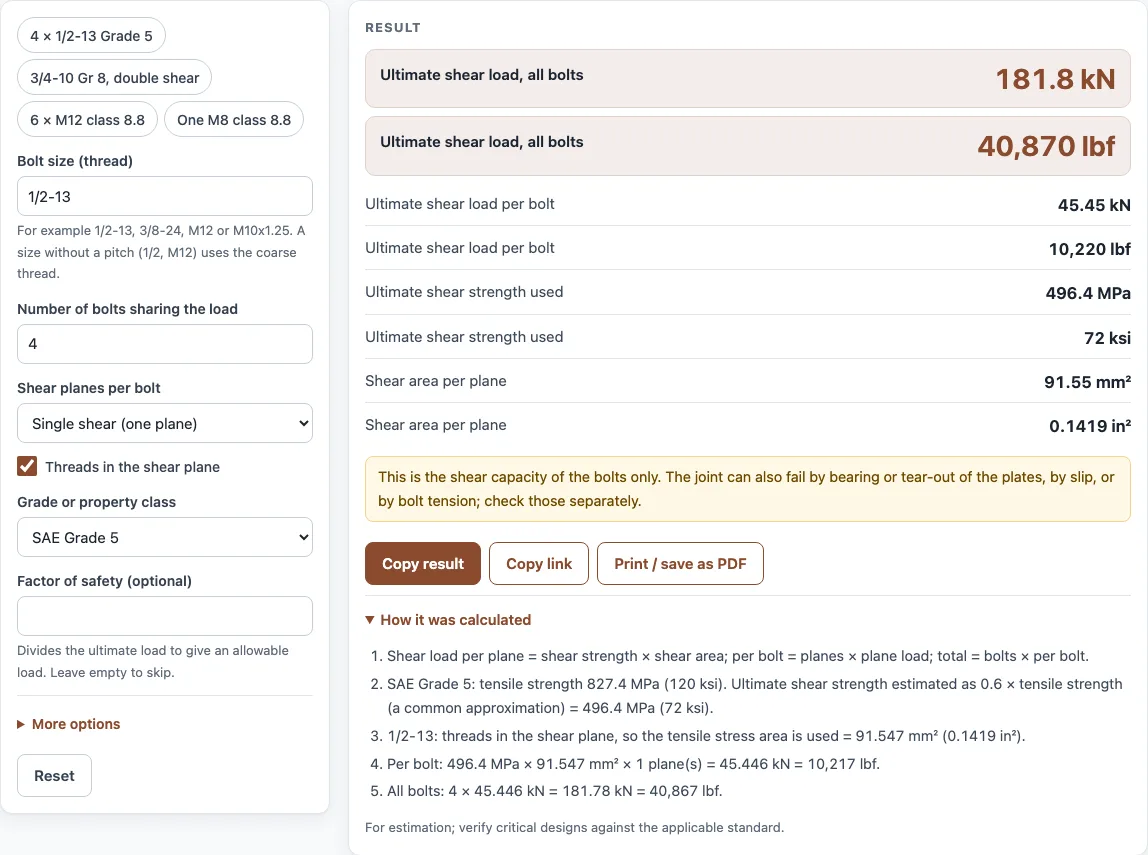
Enter the bolt size, number of bolts, shear planes per bolt, thread condition, and grade or class, and the results update as you type. You can use it as a bolt shear calculator or a thread shear calculator, since it lets you compare threads in the shear plane with a plain shank. Results show the ultimate shear load for all bolts and per bolt in kN and lbf, plus the allowable load, the shear strength used, and the shear area per plane.
How to use the Bolt Shear Strength Calculator
- Choose the bolt size (thread), such as 1/2-13 or M12.
- Enter the number of bolts sharing the load.
- Select shear planes per bolt: single shear (one plane) or double shear (two planes).
- Set threads in the shear plane to yes or no. Yes uses the thread root area, π ÷ 4 × (d − 1.299 × P)². No uses the full shank area.
- Pick the grade or class from the list, or choose the option to enter the shear strength yourself and type in a value in MPa or ksi.
- Optionally, enter a factor of safety to get an allowable load.
- Read the results. The ultimate shear load appears for all bolts and per bolt, and the allowable load appears if you entered a factor of safety.
Open How it was calculated to see the formula and each step with your numbers. Use Copy result to copy the result lines with a link, or Copy link to copy the page address. The address stores every input, so opening it later restores the same calculation. Print / save as PDF prints the inputs, results, calculation steps, and the date.
The presets show four 1/2-13 Grade 5 bolts, a 3/4-10 Grade 8 bolt in double shear, six M12 class 8.8 bolts and one M8 class 8.8 bolt.
How do you calculate bolt shear strength?
Bolt shear strength is the shear load a bolt can carry before it is cut through. The calculator multiplies four values: the number of bolts, the number of shear planes per bolt, the shear area per plane, and the shear strength. Ultimate shear load = bolts × planes × area × shear strength, and allowable load = ultimate ÷ factor of safety.
By default, shear strength is 0.6 times the grade’s tensile strength, the approximation Fastenal’s bolted joint design guide uses for carbon steel bolts. The fraction can be edited, or you can enter your own value. For example, four 1/2-13 SAE Grade 5 bolts in single shear with threads in the plane use a thread root area of about 81.1 mm² (0.126 in²) per bolt and a shear strength of about 496 MPa. That gives 4 × 81.1 × 496 ≈ 161.0 kN. This is the bolts’ capacity only. The joint can still fail by bearing or tear-out of the plates, by slip, or by bending of the bolt.
What is single shear vs double shear?
Single shear means the bolt is cut in one place, with one shear plane between two parts. Double shear means the bolt passes through three plates, or a clevis, and is cut in two places. Each cut is a shear plane, so double shear doubles the capacity of each bolt. In the same example, changing from single to double shear raises the ultimate load from 181.8 kN to 363.6 kN.
Does it matter if threads are in the shear plane?
Yes. When threads are in the shear plane, the calculator uses the thread root area, which is smaller than the full shank area. When threads are excluded, it uses the full shank area, π d² ÷ 4. For the same four 1/2-13 Grade 5 bolts in single shear, the load rises from 161.0 kN with threads in the plane to 251.5 kN with threads out of the plane. Check the thread condition at the actual shear location, because threads often sit in the plane in a standard joint.
Sources
Checked October 2026:
- Fastenal, Bolted Joint Design: T = K × D × P, nut factor ranges, 75 % of proof load in the worked example, shear strength about 60 % of tensile strength and thread root area for shear through the threads
- SAE J429 grades 2, 5 and 8 (Baco Enterprises table): proof and minimum tensile strength by size range
- ISO 898-1 property classes (TR Fastenings): proof stress and minimum tensile strength of classes 4.6, 8.8, 10.9 and 12.9
- Wikipedia, Unified Thread Standard for UNC/UNF threads per inch and number-size diameters (0.060 + 0.013 × N in)
- Wikipedia, ISO metric screw thread for ISO 261/262 coarse and fine pitches
For estimation; verify critical designs against the applicable standard.
Worked examples
| Input | Result |
|---|---|
| 4 × 1/2-13, SAE Grade 5, Single shear (one plane), threads in the plane | ultimate shear load 161 kN (36,200 lbf) |
| 4 × 1/2-13, SAE Grade 5, Double shear (two planes), threads in the plane | ultimate shear load 322.1 kN (72,410 lbf), allowable 107.4 kN |
| 4 × 1/2-13, SAE Grade 5, Single shear (one plane), threads out of the plane | ultimate shear load 251.5 kN (56,550 lbf) |
| 6 × M12, ISO class 8.8, Single shear (one plane), threads in the plane | ultimate shear load 214 kN (48,110 lbf), allowable 53.5 kN |
| 2 × M10, Enter the shear strength myself, Single shear (one plane), threads in the plane | ultimate shear load 40.73 kN (9,157 lbf) |
Calculated by the tool above with these values.
Frequently asked questions
What is the shear strength of a grade 8 bolt?
Using the calculator’s default, the shear strength is 0.6 times the grade’s tensile strength. SAE Grade 8 has a minimum tensile strength of 150 ksi, so the default shear strength is about 90 ksi (620 MPa). You can edit the 0.6 fraction if your design uses a different value.
How much shear load can an M12 8.8 bolt take?
Six M12 class 8.8 bolts in single shear with threads in the plane give an ultimate shear load of 214.0 kN (48,110 lbf). That works out to about 35.7 kN per bolt. The allowable load in this example is 53.50 kN, which is 214.0 ÷ 4, so it uses a factor of safety of 4.
What does the factor of safety do?
The factor of safety divides the ultimate shear load to give the allowable load. It is optional, so you can leave it blank if you only need the ultimate capacity. Choose a value that matches your design rules or your organisation’s requirements.
Can I enter my own shear strength value?
Yes. Instead of choosing a grade, you can enter the shear strength yourself in MPa or ksi. For example, two M10 bolts in single shear with threads in the plane and a value you enter give an ultimate shear load of 46.39 kN (10,430 lbf).
Can I use the results in my own work?
Yes. The results may be used in commercial work, including quotes, customer calculations, shop paperwork, and reports, without attribution.
Related tools
- Bolt size chart - Look up thread sizes and dimensions when you need to confirm the bolt size before you calculate.
- Bolt torque calculator - Work out the tightening torque for a bolt when you are setting up a joint.
- Stress calculator - Check stress in a part when you need more than the bolt’s shear capacity.
- Factor of safety calculator - Compare a load against a strength to find the factor of safety for your design.
- Bolt head size chart - Find the wrench size for a bolt head when you plan the assembly work.
- All calculators - Browse every calculator on the site when you need a different tool.