Bolt Torque Calculator
Enter the bolt size, grade and nut factor to get the tightening torque for a target preload, or the clamp force a given torque produces.
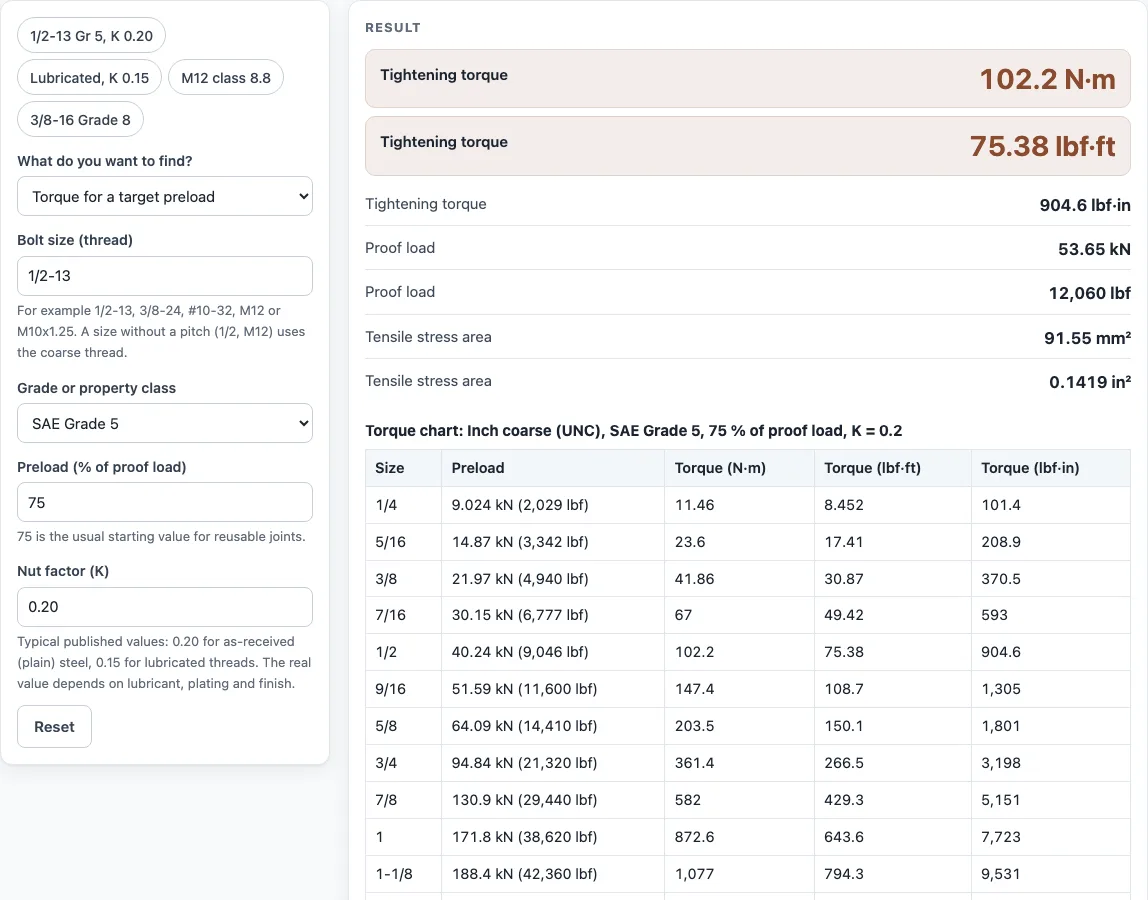
The Bolt Torque Calculator gives the tightening torque a bolt needs to reach a target preload, or the preload that a given torque produces. You enter the bolt size, grade or property class, preload percentage and nut factor K, and the results appear in N·m, lbf·ft and lbf·in. It runs in your browser, is free to use, and needs no sign-up.
Use it when you need a torque value for a fastener specification, a quote, a shop record or a joint calculation. The results are estimates. The preload a torque wrench actually produces depends on lubrication, plating, thread condition and surface finish, so check the output against the values your joint designer or fastener supplier publishes.
How to use the Bolt Torque Calculator
- Choose the mode: find the torque for a target preload, or find the preload a given torque produces.
- Enter the bolt size as a thread, such as 1/2-13, or as a metric size, such as M12.
- Select the grade or property class, such as SAE Grade 5, SAE Grade 8, ISO 8.8 or ISO 10.9. If your bolt is not listed, enter a custom proof strength.
- Set the preload as a percent of proof load. The default is 75 %.
- Set the nut factor K. The default is 0.20 for as-received dry steel. Use the 0.15 preset for lubricated threads, or enter your own value.
- Read the results: tightening torque in N·m, lbf·ft and lbf·in; preload in kN and lbf; preload as a percent of proof load; proof load; and tensile stress area.
- Check the warnings. The tool flags preloads above 90 % of proof load, which is close to yield, and above 100 %, where the bolt would yield or break.
- Open “How it was calculated” to see the formula and each step with your numbers.
- Scroll to the torque chart to see values for every size in the bolt’s thread series.
Results update as you type. Copy result copies the result lines with a link. Copy link copies the page address, which stores your inputs so the same calculation reopens later. Print / save as PDF prints the inputs, results, calculation steps and date. The tool works on a phone.
How do you calculate bolt torque?
Bolt torque is the nut factor K multiplied by the preload F and the nominal bolt diameter d: T = K × F × d. The tool solves this equation for you, but you can check any result by hand using the same three values.
For example, take a 1/2-13 SAE Grade 5 bolt at 75 % of proof load with K = 0.20. The preload is 40.24 kN. The nominal diameter is 0.5 in, or 12.7 mm. So T = 0.20 × 40,240 N × 0.0127 m = 102.2 N·m, which is 75.38 lbf·ft. Lowering K to 0.15 for lubricated threads gives 76.65 N·m for the same preload. The same preload needs less torque when the threads are lubricated, because less of the applied torque is lost to friction.
Reverse the calculation to find the preload a torque produces. For 75 lbf·ft on the same bolt with K = 0.20, the preload is 9,000 lbf, or 40.03 kN. That is 74.6 % of proof load.
What is bolt preload?
Bolt preload is the tension the tightened bolt holds in the joint, also called clamp force. It is the force that squeezes the parts together, and it is what keeps the joint from loosening under load.
The tool calculates preload as the chosen percentage of proof load. Proof load equals the proof strength of the grade multiplied by the tensile stress area of the thread. For a 1/2-13 Grade 5 bolt, the proof load at 75 % gives a preload of about 40.2 kN. The default of 75 % is a common target, and you can change it. Above 90 % of proof load the tool warns that the bolt is close to yield, and above 100 % it warns that the bolt would yield or break.
Sources
Checked October 2026:
- Fastenal, Bolted Joint Design: T = K × D × P, nut factor ranges, 75 % of proof load in the worked example, shear strength about 60 % of tensile strength and thread root area for shear through the threads
- Tensile stress area At = 0.7854 (d − 0.9743/n)² (inch) and As = 0.7854 (d − 0.9382 P)² (metric), as in ASME B1.1, ISO 898-1 and Machinery’s Handbook
- SAE J429 grades 2, 5 and 8 (Baco Enterprises table): proof and minimum tensile strength by size range
- ISO 898-1 property classes (TR Fastenings): proof stress and minimum tensile strength of classes 4.6, 8.8, 10.9 and 12.9
For estimation; verify critical designs against the applicable standard.
Worked examples
| Input | Result |
|---|---|
| 1/2-13, SAE Grade 5, K = 0.20, 75 % | 102.2 N·m = 75.38 lbf·ft for a preload of 40.24 kN |
| 1/2-13, SAE Grade 5, K = 0.15, 75 % | 76.65 N·m = 56.54 lbf·ft for a preload of 40.24 kN |
| M12, ISO class 8.8, K = 0.20, 75 % | 87.97 N·m = 64.89 lbf·ft for a preload of 36.66 kN |
| 3/8-16, SAE Grade 8, K = 0.20, 75 % | 59.1 N·m = 43.59 lbf·ft for a preload of 31.02 kN |
| 1/2-13, SAE Grade 5, K = 0.20, 75 lbf·ft | preload 40.03 kN (9,000 lbf) = 74.6 % of proof load |
Calculated by the tool above with these values.
Frequently asked questions
How much torque for a 1/2 inch grade 5 bolt?
At 75 % of proof load with K = 0.20, the torque is 102.2 N·m (75.4 lbf·ft), which produces a preload of 40.2 kN. With K = 0.15 for lubricated threads, the torque is 76.7 N·m (56.5 lbf·ft) for the same preload.
What torque for an M12 8.8 bolt?
For an M12 ISO class 8.8 bolt at 75 % of proof load with K = 0.20, the torque is 88.0 N·m (64.9 lbf·ft). That gives a preload of 36.7 kN.
What is the nut factor K?
The nut factor K is a number that describes the friction in the threads and under the nut or bolt head. The tool uses 0.20 for as-received dry steel and 0.15 for lubricated steel. Because K changes with lubricant, plating, thread condition and surfaces, the same torque can produce a wide range of preloads.
Should bolts be torqued dry or lubricated?
Choose the K value that matches the condition of your bolt when you tighten it. The tool’s 0.20 default assumes dry, as-received steel, and 0.15 assumes lubricated steel. Lubrication changes the preload a given torque produces, so the torque you set must match the condition you use. For a specific finish or lubricant, use the values your joint designer or fastener maker publishes.
Does torque set the preload exactly?
No. Torque only sets preload within a wide scatter, because K varies with lubricant, plating, thread condition and surfaces. Treat the calculated preload as an estimate.
What torque for a 3/8-16 grade 8 bolt?
At 75 % of proof load with K = 0.20, a 3/8-16 SAE Grade 8 bolt needs 59.1 N·m (43.6 lbf·ft). That gives a preload of 31.0 kN.
Related tools
- Bolt size chart — Use it to look up thread sizes and dimensions before you enter a bolt size here.
- Bolt head size chart — Use it to find the wrench size for a bolt head.
- Bolt shear strength calculator — Use it when the load on the bolt acts across the joint rather than along it.
- Stress calculator — Use it to check stresses in a part under load.
- Factor of safety calculator — Use it to compare a design load with the strength of a component.
- Bolt grade chart — Use it to identify a bolt grade and see its proof load.
- All calculators — Use it to browse every calculator on the site.