Cable Sag Calculator
Enter the span, the sag, the cable weight and any load at midspan to get the horizontal and maximum cable tension, or solve for the sag.
The Cable Sag Calculator finds the tension in a cable hung between two supports at the same height. Enter the span, how far the cable sags at midspan, the cable’s own weight per length and any weight at midspan, such as a rider on a zipline, and it returns the horizontal tension, the larger tension at the supports, the vertical reaction and the cable length. You can also solve the other way: set the tension you will pull the cable to and find the sag.
The result matters because tension climbs steeply as a cable gets tighter. A cable with 1 % sag can carry many times the load in its tension, which is why tension and anchor strength must be checked before a cable line is built. Everything runs in your browser; nothing is stored.
How to use the Cable Sag Calculator
- Choose what to solve for: Tension, from the sag, or Sag, from the horizontal tension.
- Enter the Span between supports. Both supports must be at the same height.
- For the tension mode, enter the Sag at midspan. For the sag mode, enter the Horizontal tension you plan to apply.
- Enter the Cable weight per length (use 0 for a weightless cable) and the Point load at midspan (use 0 for none). A rider of 80 kg is about 785 N.
- Optionally open More options and type the cable’s breaking strength to get a safety factor.
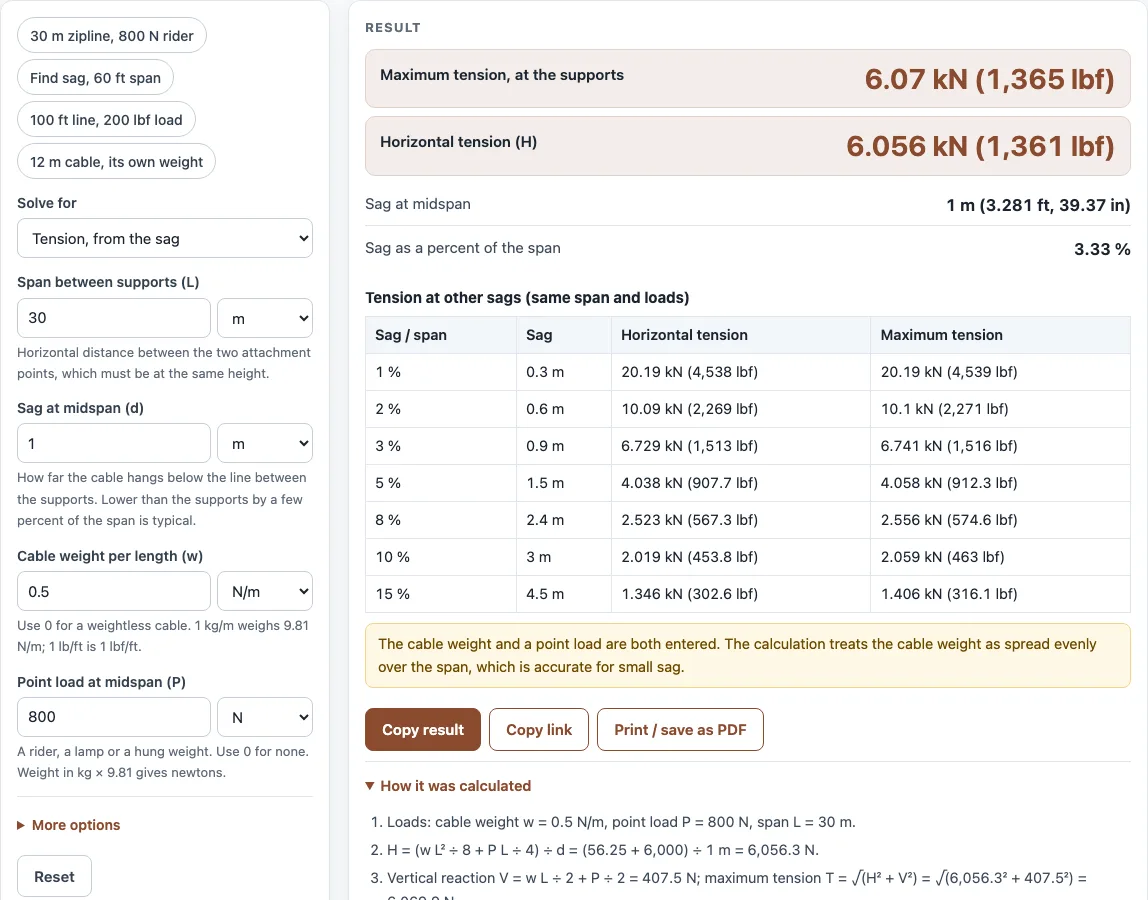
- Read the maximum tension, the horizontal tension, the sag, the sag as a percent of span and the cable length. The table lists tension at other sag values for the same span and loads.
The presets load a 30 m zipline with an 800 N rider, a sag solution on a 60 ft span, a 100 ft line with a 200 lbf load and a 12 m cable carrying only its own weight. Copy link keeps the inputs in the address, and Print / save as PDF prints the result, the steps and the date. Change the sag step by step to see how quickly the tension rises as the cable is pulled tighter. Nothing you type is uploaded.
How do you calculate the tension in a sagging cable?
For a cable with weight w per unit of span, the horizontal tension is H = w L² ÷ (8 d), where L is the span and d the sag. A weight P at midspan adds P L ÷ 4 to the moment, so H = (w L² ÷ 8 + P L ÷ 4) ÷ d. The vertical pull at each support is V = w L ÷ 2 + P ÷ 2, and the largest tension, at a support, is T = √(H² + V²).
For the default 30 m span with 1 m sag, 0.5 N/m cable and an 800 N rider, H is (56.25 + 6000) ÷ 1 = 6056 N and V is 407.5 N, so the maximum tension is about 6070 N (1,365 lbf).
How much does tension go up as sag goes down?
Almost in inverse proportion. Halving the sag doubles the horizontal tension, so a tight cable can carry many times the load in tension. That is why a line pulled “nearly straight” is dangerous for anchors and fittings, and why the page warns when the sag falls below 1 % of the span.
What sag should a zipline have?
The calculator gives tension for any sag you enter; it does not state a safe sag. Real ziplines are designed to a standard that sets sag, tension, braking and factors of safety, so ask a qualified designer. The table shows what tension you get at each sag.
What is the difference between a parabola and a catenary?
A cable that carries a load spread evenly along the horizontal span, like a bridge deck, hangs in a parabola. A cable carrying only its own weight, spread along its length, hangs in a catenary, y = a cosh(x ÷ a). For sag below about 10 % of the span the two shapes give nearly the same tension, so this calculator uses the parabola and warns above 20 %. For a long, slack cable with only its own weight, use a catenary tool.
How long is the cable?
For a cable carrying only its own weight the length is about L + 8 d² ÷ (3 L). With a point load only, the cable forms two straight sections, each of length √((L ÷ 2)² + d²). The page shows the length when one of the two loads is zero; a mixed load has no simple formula here.
Sources
- Catenary (Wikipedia): the parabola for a load uniform per horizontal length, T₀ = w L² ÷ (8 h), the catenary y = a cosh(x ÷ a) and tension relations. Checked October 2026.
- Point load at midspan: static moment balance about a support, H d = P L ÷ 4 (textbook cable statics, e.g. Hibbeler, Engineering Mechanics: Statics).
- Cable length formulas are the standard parabolic-arc and straight-segment results. The page does not include dynamic effects, cable stretch, wind or ice.
Worked examples
| Input | Result |
|---|---|
| span 30 m, Tension, from the sag | sag 1 m (3.281 ft, 39.37 in), max tension 6.07 kN (1,365 lbf) |
| span 60 ft, Sag, from the horizontal tension | sag 0.06101 m (0.2002 ft, 2.402 in), max tension 4 kN (899.3 lbf) |
| span 100 ft, Tension, from the sag | sag 1.219 m (4 ft, 48 in), max tension 5.929 kN (1,333 lbf) |
| span 12 m, Tension, from the sag | sag 0.3 m (0.9843 ft, 11.81 in), max tension 0.9045 kN (203.3 lbf) |
Calculated by the tool above with these values.
Frequently asked questions
Does the calculator include the stretch of the cable?
No. It treats the cable as inextensible and the supports as rigid. A stretchy cable under load sags more than the figure shown, and the tension changes slightly.
Can the supports be at different heights?
Not in this calculator. It assumes level supports. With supports at different heights, the tension at the higher support is larger, and you need a method for inclined spans.
What load do I enter for a person?
Enter their weight as a force: kilograms times 9.81 for newtons, or pounds directly as pounds-force. The calculator does not add a dynamic factor for jumping or sudden stops, which can be much larger than static weight.
Is the maximum tension at the supports or in the middle?
At the supports. The horizontal part of the tension is the same along the cable, but the vertical part is largest at the supports, so the total is largest there. Choose fittings and anchors for the maximum tension.
How does the safety factor work?
Enter the cable’s breaking strength from its data sheet and the page divides it by the maximum tension. A factor below 2 triggers a warning. The needed factor depends on the standard for your use.
Related tools
- Factor of safety calculator: use it to compare breaking load with working load.
- Stress calculator: use it to find axial stress in a cable of a given cross-section.
- Truss calculator: use it to find member forces in a framed structure.
- Beam load calculator: use it to find how much a beam can carry.
- Hoop stress calculator: use it for pressure vessels and pipes.
- All fabrication calculators: use it to browse every calculator on the site.