Factor of Safety Formula and Calculator
Divide strength by stress, or failure load by working load, to get the factor of safety; or find the allowable stress for a required factor.
The factor of safety formula is FoS = strength ÷ working stress, or FoS = failure load ÷ working load when you compare forces. This free Factor of Safety Calculator works out the factor of safety, allowable stress and required strength for you, using the formula that matches the values you enter. It runs in your browser with no sign-up, and the results update as you type.
The tool has four modes: factor of safety from stresses, factor of safety from loads, allowable stress from strength, and required strength from stress. You can also enter a required factor of safety to check whether a design passes. Use it for quick engineering checks, quotes, shop paperwork or reports. Results can be used in commercial work without attribution.
How to use the Factor of Safety Calculator
- Choose the mode that matches what you need to find: factor of safety from stresses, factor of safety from loads, allowable stress from strength, or required strength from stress.
- Choose the strength type you mean: yield strength (Sy) or ultimate strength (Su).
- Enter the strength and the working stress, or the failure load and the working load, using your own units.
- Optional: enter a required factor of safety. The tool then shows PASS or FAIL, the margin of safety (MS), and the capacity used (%).
- Read the results. They update as you type, so you can change a value and see the effect straight away.
- Open “How it was calculated” to see the formula and each step with your numbers.
Copy result copies the result lines with a link. Copy link copies the page address, which stores every input in the address (?s=…). Open that address later to restore the same calculation. Print / save as PDF prints the inputs, results, calculation steps and the date, which is useful for shop paperwork. The tool also works on a phone.
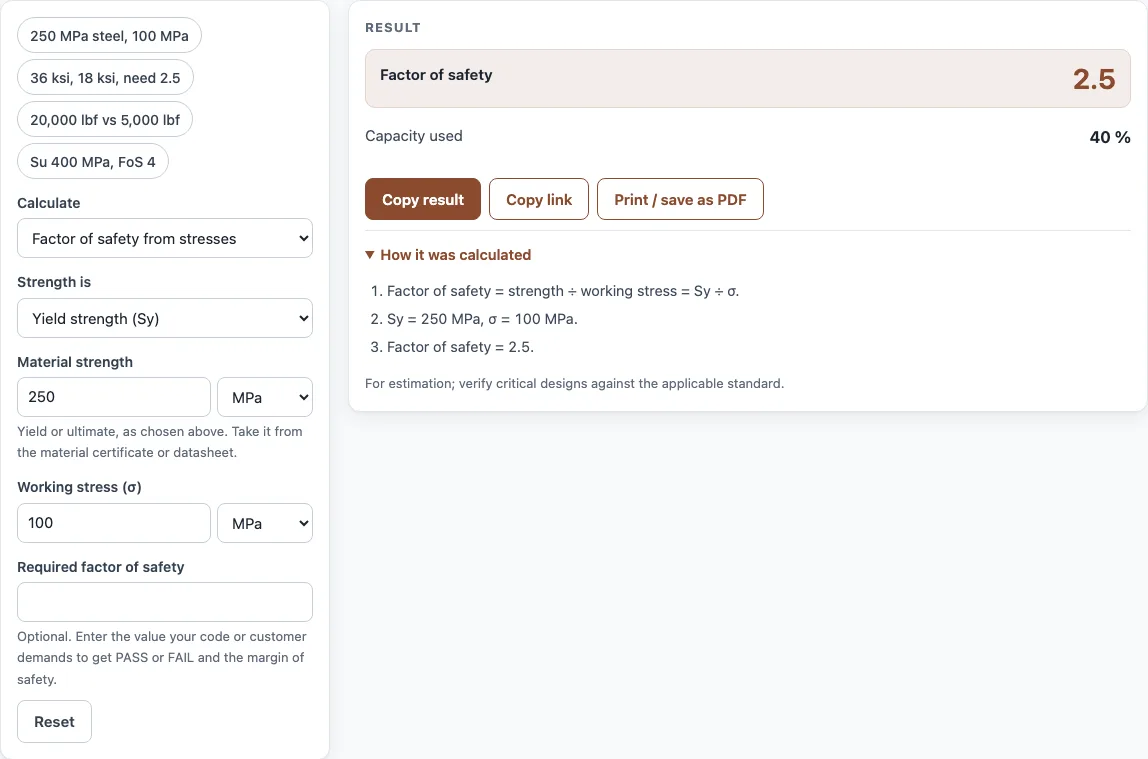
The presets show each mode with real numbers: steel at 250 and 100 MPa, a 36 ksi part needing 2.5, a load case and an allowable stress.
What is the factor of safety formula?
The factor of safety formula is FoS = strength ÷ working stress when you work with stresses, and FoS = failure load ÷ working load when you work with forces. A higher value means the part has more reserve before it fails. The same idea can be rearranged: allowable stress = strength ÷ FoS, and required strength = stress × FoS.
Strength can be yield strength (Sy) or ultimate strength (Su), so choose the one your design rules call for. For example, a part with Sy of 250 MPa under a working stress of 100 MPa has FoS = 250 ÷ 100 = 2.5. For loads, a failure load of 20,000 lbf against a working load of 5,000 lbf gives FoS = 20,000 ÷ 5,000 = 4.
A FoS below 1 predicts failure, because the working stress or load is greater than the strength or failure load.
What is the difference between factor of safety and margin of safety?
The factor of safety is a ratio, while the margin of safety expresses the spare capacity above the required value. The tool calculates margin of safety as MS = FoS ÷ required − 1. Multiply the result by 100 to read it as a percentage.
Take the example above with a required FoS of 2. The margin of safety is 2.5 ÷ 2 − 1 = 0.25, or 25%. This means the design has 25% more capacity than the requirement asks for. The capacity used (%) is the other side of the same check: for a stress case, it is the working stress divided by strength, which is 100 ÷ FoS percent. Here that gives 40%.
What is the factor of safety equation for loads?
The factor of safety equation for loads is the same ratio applied to forces: FoS = failure load ÷ working load. Use it when you know the load a part fails at (from a test or a rated capacity) rather than a stress. A hoist rated to fail at 20,000 lbf carrying 5,000 lbf has FoS = 4.
Sources
Checked October 2026:
- Wikipedia, Factor of safety: factor of safety = strength ÷ applied stress and margin of safety = failure load ÷ (design factor × design load) − 1
For estimation; verify critical designs against the applicable standard.
Worked examples
| Input | Result |
|---|---|
| Sy = 250 MPa, σ = 100 MPa | FoS = 2.5 – PASS – at or above the required factor of safety 2 |
| Sy = 36 ksi, σ = 18 ksi | FoS = 2 – FAIL – below the required factor of safety 2.5 |
| Ffail = 20000 lbf, Fwork = 5000 lbf | FoS = 4 |
| Su = 400 MPa, FoS = 4 | σallow = 100 MPa |
| σ = 15000 psi, FoS = 3 | Required strength = 45,000 psi |
Calculated by the tool above with these values.
Frequently asked questions
What is a good factor of safety?
There is no single good value that suits every design. The required factor comes from the applicable code, the customer, or your company’s design rules, not from the calculator. Enter that value in the required field to see whether your design passes.
Should I use yield or ultimate strength?
Use the strength type that your code or design rules specify. Yield strength marks the point where permanent deformation begins, while ultimate strength marks the maximum stress the material can take before breaking. Note which one you used in any report.
How do you calculate allowable stress?
Divide the strength by the factor of safety: σallow = strength ÷ FoS. For example, an ultimate strength of 400 MPa with a FoS of 4 gives an allowable stress of 100 MPa. Select the allowable stress from strength mode to do this calculation.
Why does my result show FAIL?
FAIL means the factor of safety is below the required value you entered. Check the strength type, the units, and the required value first. If those are correct, the working stress or load is too high for the strength you have.
Can I use the results in a customer quote or report?
Yes. Results may be used in commercial work, such as quotes, customer calculations, shop paperwork and reports, without attribution. The required factor of safety should still come from the relevant code or the customer’s requirements.
Related tools
- Stress calculator: use it to work out the stress in a part before you compare it with a strength value.
- Principal stress calculator: use it when a part is under more than one stress direction and you need the principal stresses.
- Hoop stress calculator: use it to find the circumferential stress in a pressurised cylinder or pipe.
- Beam load calculator: use it to find the loads on a beam before you check them against a strength value.
- Bolt shear strength calculator: use it to check the shear strength of a bolt in a joint.
- Cable sag calculator: use it to find the tension in a cable before you compare it with the breaking load.
- All calculators: use it to browse every calculator on the site.