Hoop Stress Formula and Calculator
Get the hoop and longitudinal stress in a pipe or vessel from pressure, diameter and wall thickness, or the pressure or wall a stress limit allows.
The hoop stress formula, σh = P D ÷ (2t), gives the stress around the circumference of a pipe or cylinder under internal pressure. This hoop stress calculator applies that formula and solves it for stress, pressure or wall thickness. It also covers Barlow’s formula for pipe ratings and the Lamé thick-wall equations for thicker walls. It runs in your browser, is free and needs no sign-up. Enter your values and the result appears as you type, in both MPa and psi. The calculation steps are shown so you can check each number before you use it.
Every result is shown in both MPa and psi.
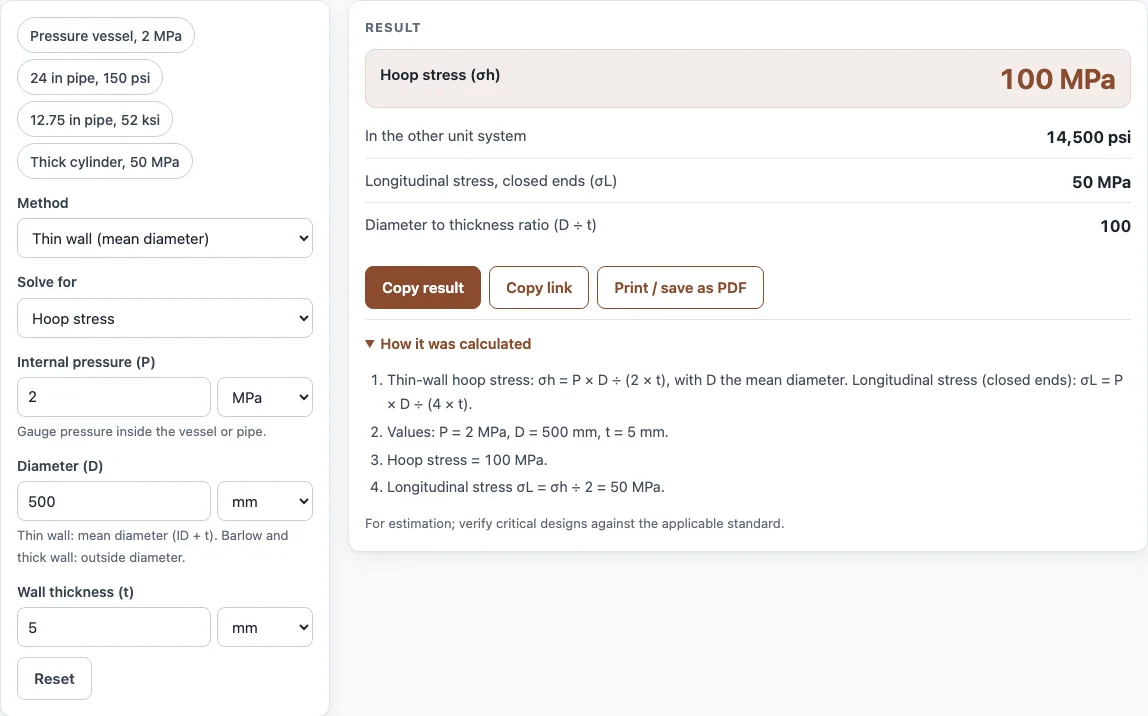
How to use the Hoop stress calculator
- Choose a method: Thin wall, Barlow’s formula or Thick wall (Lamé).
- In thin wall or Barlow mode, choose what to solve for: hoop stress, pressure or wall thickness.
- Enter your known values. For thin wall, use the mean diameter. For Barlow, use the outside diameter, and enter the allowable stress S when solving for pressure or wall thickness.
- For thick wall, enter the internal pressure, the inside diameter and the outside diameter. The tool also shows the thin-wall result and its error next to the thick-wall values.
- Read the result. It updates as you type, and every answer is shown in both MPa and psi.
- If D ÷ t is below 20, the tool warns you. The thin-wall formula underestimates the peak stress in that range, so switch to the thick-wall method.
- Open “How it was calculated” to see the formula and each step with your numbers.
Copy result copies the result lines with a link. Copy link copies the page address, which stores every input (?s=…), so opening it later restores the same calculation. Print / save as PDF prints the inputs, results, calculation steps and the date. The tool also works on a phone.
What is the hoop stress formula?
The hoop stress formula is σh = P D ÷ (2t), where P is the internal pressure, D is the diameter and t is the wall thickness. It applies to a thin-walled cylinder, and the stress acts around the circumference, trying to split the pipe along its length.
The longitudinal stress acts along the length of the cylinder. For closed ends it is σL = P D ÷ (4t), half the hoop stress. For example, 2 MPa in a 500 mm vessel with a 5 mm wall gives σh = 2 × 500 ÷ (2 × 5) = 100 MPa. In psi, 150 psi in a 24 in pipe with a 0.25 in wall gives 7,200 psi. Units must match: use the same unit for pressure and stress, and the same length unit for diameter and thickness.
What is Barlow’s formula?
Barlow’s formula is the pipe form of the hoop stress equation: σ = P × OD ÷ (2t), where OD is the outside diameter. It is used for pipe where the outside diameter is the standard dimension.
Rearranged, it gives two useful forms. The allowable pressure is P = 2St ÷ OD, and the required wall thickness is t = P × OD ÷ (2S), where S is the allowable stress of the material. For example, with S = 52,000 psi, OD = 12.75 in and t = 0.375 in, the allowable pressure is 3,059 psi. In metric, P = 7 MPa, S = 240 MPa and OD = 323.9 mm give a required wall of t = 4.724 mm.
How does the thick-wall formula differ?
For thick walls the hoop stress is not uniform: it is highest at the bore and lower at the outside. Lamé’s equations give σθ = P (ro² + ri²) ÷ (ro² − ri²) at the inner surface, so a 100 mm bore in a 200 mm cylinder at 50 MPa carries 83.3 MPa at the bore and 33.3 MPa outside.
Sources
Checked October 2026:
- Wikipedia, Cylinder stress for thin-wall hoop and longitudinal stress, the D/t > 20 thin-wall limit, Barlow’s formula and Lamé’s thick-wall equations
For estimation; verify critical designs against the applicable standard.
Worked examples
| Input | Result |
|---|---|
| P = 2 MPa, D = 500 mm, t = 5 mm | σ = 100 MPa |
| P = 150 psi, D = 24 in, t = 0.25 in | σ = 7,200 psi |
| S = 52000 psi, OD = 12.75 in, t = 0.375 in | P = 3,059 psi |
| P = 7 MPa, S = 240 MPa, OD = 323.9 mm | t = 4.724 mm |
| P = 50 MPa, ID = 100 mm, OD = 200 mm | σθ (inner) = 83.33 MPa, σθ (outer) = 33.33 MPa |
Calculated by the tool above with these values.
Frequently asked questions
What is the difference between hoop stress and longitudinal stress?
Hoop stress acts around the circumference and is σh = P D ÷ (2t). Longitudinal stress acts along the length of the cylinder and, with closed ends, is P D ÷ (4t), which is half the hoop value.
When should I use the thick-wall formula?
Use the thick-wall (Lamé) method when D ÷ t is below 20, because the thin-wall formula underestimates the peak stress there. For example, 50 MPa with an inside diameter of 100 mm and an outside diameter of 200 mm gives 83.33 MPa at the inner surface and 33.33 MPa at the outer surface.
How do I calculate the required pipe wall thickness?
Use Barlow’s formula rearranged: t = P × OD ÷ (2S). Choose Barlow’s formula, then select wall thickness as the value to solve for. Enter the pressure, outside diameter and allowable stress. For 7 MPa, S = 240 MPa and OD = 323.9 mm, the required thickness is 4.724 mm.
What is the wall stress formula?
Wall stress in a cylinder under internal pressure usually means the hoop stress. For a thin wall it is σh = P D ÷ (2t). For a pipe, Barlow’s form uses the outside diameter: σ = P × OD ÷ (2t).
Does the tool cost anything or need an account?
No. The calculator is free, needs no sign-up, and does not upload your inputs. It runs in your browser on a computer or a phone.
Can I use the results in commercial work?
Yes. Results may be used in commercial work, such as quotes, calculations for customers, shop paperwork and reports, without attribution.
Related tools
- Stress calculator: use it for general stress checks when your load is not internal pressure.
- Principal stress calculator: use it when you need the principal stresses from combined stress components.
- Factor of safety calculator: use it to compare a calculated stress with the material’s strength.
- Pipe bending calculator: use it when the pipe will also be bent.
- All calculators: use it to browse every tool on the site.