Moment of Inertia Calculator
Choose a cross-section and enter its dimensions to get the area moment of inertia about both axes, the section modulus and the centroid.
How to use the Moment of Inertia Calculator
- Choose a shape: rectangle (solid bar), rectangular tube, round bar, round tube (pipe), I-beam, channel, angle or T-section.
- Select your unit: mm, cm or in. Enter every dimension in that unit.
- Type the dimensions the form asks for for your shape. Check each value against your drawing or material list.
- Read the results. They update as you type, so change one value at a time to see its effect. Ix and Iy are the values for bending about each centroidal axis.
- Open “How it was calculated” to see the formula and each step with your own numbers. Use it to check your working line by line.
- Save or share the result. Copy result copies the result lines with a link. Copy link copies the page address, which stores every input, so opening it later restores the same calculation.
Print / save as PDF produces a record with your inputs, results, calculation steps and the date. This suits shop paperwork, quotes and reports.
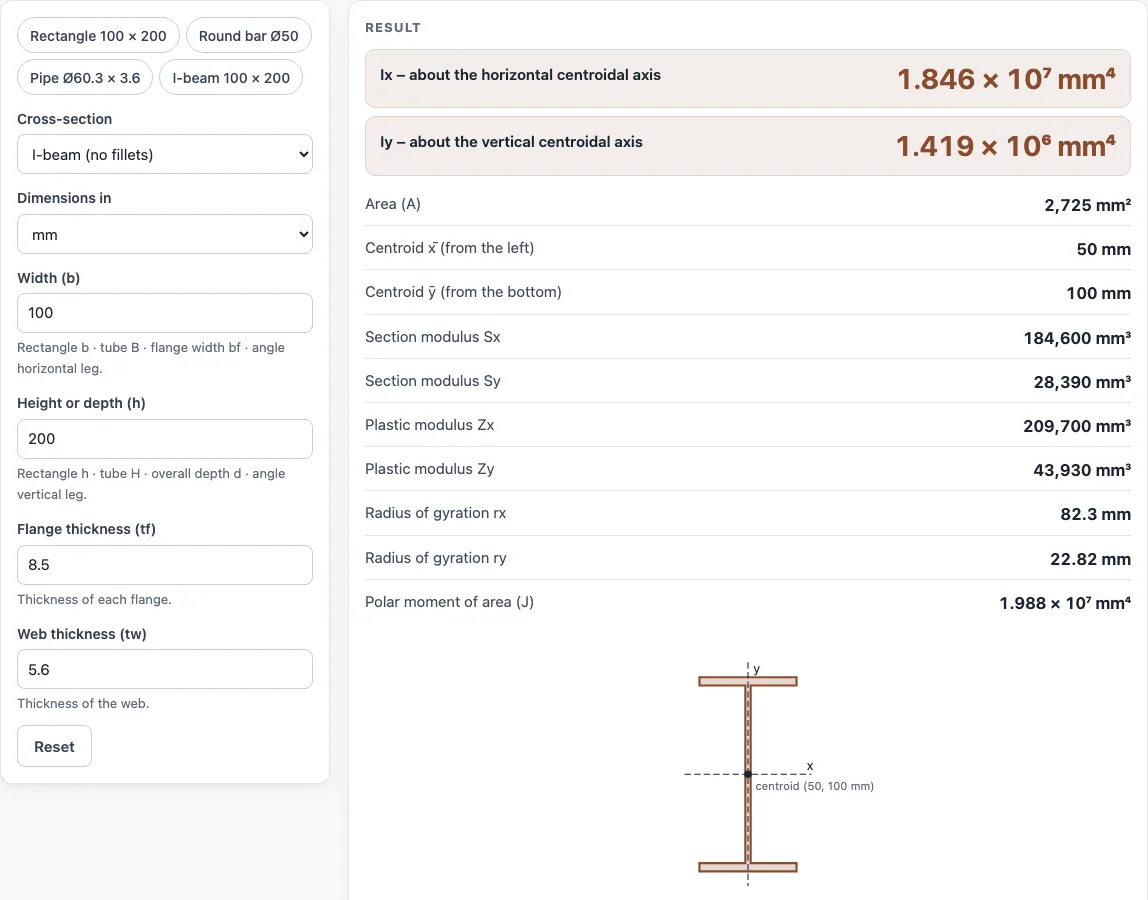
Use the presets to see a 100 × 200 mm rectangle, a Ø50 round bar, a Ø60.3 × 3.6 pipe and a 100 × 200 I-beam, then change the dimensions to your own section.
Values are shown in the unit you choose.
What is the area moment of inertia formula?
The area moment of inertia measures how a cross-section resists bending about an axis. It depends on the shape and on how far its area sits from that axis. It is written I, has units of length to the fourth power (mm⁴ or in⁴), and appears in bending stress and deflection equations.
The basic formulas are:
- Rectangle: I = b h³ ÷ 12, where b is the width and h is the depth, both measured perpendicular to the axis.
- Round bar: I = π d⁴ ÷ 64, where d is the diameter.
- Round tube: I = π (D⁴ − d⁴) ÷ 64, where D is the outside diameter and d is the inside diameter.
I-beams, channels, angles and T-sections are built from rectangles. For these, find each rectangle’s own moment about its centroid, add the area times the square of the distance from that rectangle’s centroid to the overall centroid, and sum the results. This is the parallel-axis theorem: I = Σ(Ic + A d²).
How do you calculate the moment of inertia of a rectangle?
Multiply the width by the depth cubed, then divide by 12. For bending about the horizontal centroidal axis (Ix), the depth is the vertical dimension, so Ix = b h³ ÷ 12. For bending about the vertical axis (Iy), swap the roles of width and depth.
Take a 100 × 200 mm rectangle with a width of 100 mm and a depth of 200 mm:
- Ix = 100 × 200³ ÷ 12 = 100 × 8,000,000 ÷ 12 = 6.667 × 10⁷ mm⁴
- Iy = 200 × 100³ ÷ 12 = 200 × 1,000,000 ÷ 12 = 1.667 × 10⁷ mm⁴
Because depth is cubed, it has far more effect than width. A beam stood on edge is much stiffer than the same beam laid flat. For a 1.5 × 5.5 in board bent about the axis along its 5.5 in depth, Ix = 1.5 × 5.5³ ÷ 12 = 20.8 in⁴.
Sources
Checked October 2026:
- Section properties by the parallel-axis theorem (Hibbeler, Mechanics of Materials; Roark’s Formulas for Stress and Strain); fillets are ignored
For estimation; verify critical designs against the applicable standard.
Worked examples
| Input | Result |
|---|---|
| Rectangle (solid bar): 100 × 200 mm | Ix = 6.667 × 10⁷ mm⁴, Iy = 1.667 × 10⁷ mm⁴ |
| Round bar: 50 mm | Ix = 306,800 mm⁴, Iy = 306,800 mm⁴ |
| Round tube (pipe): 60.3 × 3.6 mm | Ix = 258,700 mm⁴, Iy = 258,700 mm⁴ |
| I-beam (no fillets): 100 × 200 × 8.5 × 5.6 mm | Ix = 1.846 × 10⁷ mm⁴, Iy = 1.419 × 10⁶ mm⁴ |
| Rectangle (solid bar): 1.5 × 5.5 in | Ix = 20.8 in⁴, Iy = 1.547 in⁴ |
Calculated by the tool above with these values.
Frequently asked questions
What is the moment of inertia of an I-beam?
It depends on the overall depth, the flange and web dimensions. A 100 × 200 mm I-beam with 8.5 mm flanges and a 5.6 mm web has Ix = 1.846 × 10⁷ mm⁴ and Iy = 1.419 × 10⁶ mm⁴ in this calculator. Rolled shapes have root fillets, so published tables give slightly higher values than this no-fillet result.
What is the difference between moment of inertia and section modulus?
Moment of inertia (I) describes the stiffness of a section, while section modulus (S) describes its bending strength. Section modulus is S = I ÷ c, where c is the distance from the centroidal axis to the outermost fibre. For unsymmetric shapes, the calculator gives separate values for top and bottom, or left and right.
What is the radius of gyration?
The radius of gyration is r = √(I ÷ A). It is the distance from the axis at which the whole area could be concentrated without changing I. For the 100 × 200 mm rectangle, with A = 20,000 mm², rx = √(6.667 × 10⁷ ÷ 20,000) ≈ 57.7 mm. It is used in column buckling checks.
What is the polar moment of inertia?
The polar moment of area, J, describes resistance to rotation about an axis perpendicular to the section. For a round bar, J = π d⁴ ÷ 32. For other shapes, J = Ix + Iy, but this is not the torsion constant, so do not use it as one.
Is the moment of inertia the same as the mass moment of inertia?
No. The area moment of inertia (in mm⁴ or in⁴) is used for bending and deflection of beams. The mass moment of inertia, which uses mass units, describes how hard it is to rotate a body, such as a shaft or wheel. This calculator gives area values only.
Related tools
- Beam deflection calculator — use it to find how far a beam bends once you know its moment of inertia.
- Beam load calculator — use it to work out the loads a beam carries before checking its section.
- Column buckling calculator — use it to check whether a column fails under compression, using the radius of gyration.
- Stress calculator — use it to find bending or other stresses in a member from applied forces.
- Shear moment diagram calculator — use it to find the bending moment along a beam before choosing a section.
- Centroid calculator — use it to find the centroid and moments of area of a shape built from several parts.
- All calculators — use it to browse every tool on the site.