Press Brake Tonnage Calculator
Enter the sheet thickness, V-die opening, bend length and tensile strength to get the air bending force per foot (or metre) and in total.
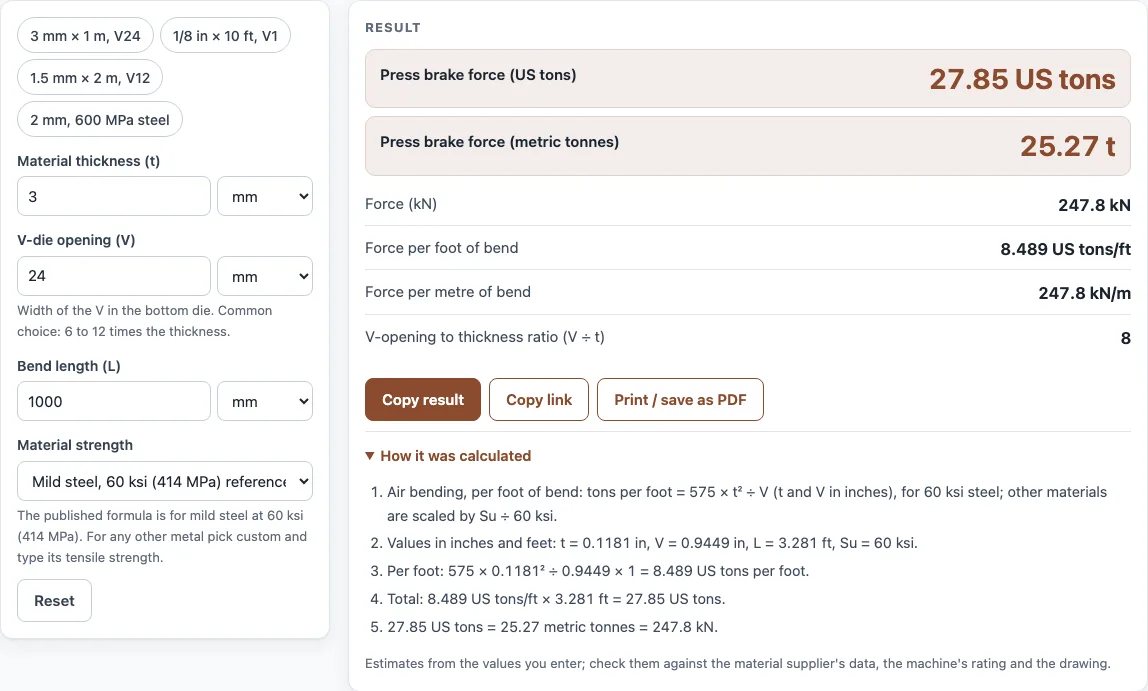
How to use the press brake tonnage calculator
- Enter the material thickness, t.
- Enter the V-die opening, V. This is the width of the groove in the lower die.
- Enter the bend length, L, and choose its unit: mm, in, m or ft.
- Choose the material. Leave the mild steel 60 ksi (414 MPa) reference selected, or enter another tensile strength.
- Read the results. They update as you type and show the total force in US tons, metric tonnes and kN, the force per foot and per metre, and the V ÷ t ratio.
- Check any warning. A V ÷ t value outside the common 6 to 12 range, or a tensile strength over three times the reference, is flagged.
- Open “How it was calculated” to see the formula and each step with your own numbers.
Copy result copies the result lines with a link. Copy link copies the page address, which stores every input (?s=…), so opening it later restores the same calculation. Print / save as PDF prints the inputs, results, calculation steps and the date, which is useful for shop paperwork.
The presets show 3 mm sheet over 1 m, 1/8 in plate over 10 ft, thin 1.5 mm sheet and a 600 MPa high-strength steel.
Every input accepts mm or inches.
How do you calculate press brake tonnage?
Air bending tonnage comes from the formula published by press brake makers. You find the force per foot of bend, then multiply it by the bend length to get the total. The calculator does both steps and shows each one under “How it was calculated”.
For example, a 1/8 in thick plate bent over a 1 in V-die needs about 8.98 US tons per foot. Over a 10 ft bend, that is 89.8 US tons in total.
What is the tonnage per foot formula?
The formula is tonnage per foot = 575 × t² ÷ V, with t and V in inches. It gives US tons per foot of bend for mild steel with a tensile strength of 60,000 psi. For other materials, the result is scaled by tensile strength ÷ 60 ksi.
Check it with a 3 mm plate and a 24 mm V-die. In inches, t is about 0.118 and V is about 0.945, which gives about 8.49 US tons per foot. Over 1 m (about 3.28 ft), that is 27.85 US tons, or 247.8 kN.
What V-die opening should I use?
Choose a V-die opening that keeps V ÷ t in the common 6 to 12 range.
The V opening affects both force and bend shape. A narrow die needs much more force, while a wide die reduces tonnage but gives a larger inside radius. Because force falls as V grows, doubling the V opening halves the tonnage.
How much tonnage to bend stainless steel?
Stainless steel is stronger than mild steel, so it needs more force for the same thickness, die and length. Find its tensile strength on the supplier’s datasheet or material certificate, then enter that value in place of the 60 ksi reference.
The calculator scales the mild steel result by tensile strength ÷ 60 ksi. For example, a tensile strength of 90 ksi gives a factor of 1.5, so the tonnage is 1.5 times the mild steel figure. If the tensile strength is more than three times the reference, the tool warns you, so check the value you entered.
Is air bending tonnage different from bottoming?
Yes. The formula on this page is for air bending only. In air bending, the sheet touches the die edges and the punch tip, and the bend angle is set by punch depth. Bottoming and coining press the sheet fully into the die and need several times more force.
This calculator does not cover bottoming or coining. For those methods, check the press brake maker’s data before you set up the job.
Sources
Checked October 2026:
- The Fabricator, The 4 pillars of press brake tonnage limits: 575 × t² ÷ V tons per foot for 60,000 psi steel in air bending, scaled by tensile strength ÷ 60,000 psi; Hackaday, The art and science of bending sheet metal for the air-bending rule of thumb of a die opening 6 to 12 times the thickness
For estimation; verify critical designs against the applicable standard.
Worked examples
| Input | Result |
|---|---|
| t = 3 mm, V = 24 mm, L = 1000 mm | 27.85 US tons (247.8 kN) |
| t = 0.125 in, V = 1 in, L = 10 ft | 89.84 US tons (799.3 kN) |
| t = 2 mm, V = 16 mm, L = 1500 mm | 40.4 US tons (359.4 kN) |
| t = 6 mm, V = 48 mm, L = 2 m | 111.4 US tons (991.1 kN) |
Calculated by the tool above with these values.
Frequently asked questions
Can I use the results in customer quotes and shop paperwork?
Yes. Results may be used in commercial work, including quotes, calculations for customers, shop paperwork and reports, without attribution.
Do I still need to check the press brake’s rating?
Yes. Compare the total tonnage with the press brake’s rated tonnage, and check the die’s load limit per foot or per metre of bend. A result below the press rating does not by itself confirm the die can take the load.
Can I work in metric units?
Yes. Enter the bend length in mm or m, and the results show metric tonnes and kN alongside US tons. Use whichever units match your drawings and your press data.
What does a warning mean?
A V ÷ t warning means your die opening is outside the common 6 to 12 range. A narrow die raises the force needed, and a wide die gives a larger inside radius, so review your die choice. A tensile strength warning means the value is over three times the 60 ksi reference, so confirm the number you entered.
Does the bend length change the tonnage per foot?
No. Tonnage per foot depends only on thickness, V opening and tensile strength; the bend length multiplies it to give the total force.
Related tools
- Punching force calculator: use it to estimate the force needed to punch holes or shapes in sheet metal.
- Blank size calculator: use it to work out the flat blank size before you form a part.
- Pipe bending calculator: use it when you are planning bends in pipe or tube rather than sheet.
- Coil length calculator: use it to estimate how much coil length you need for a run of parts.
- Stress calculator: use it to check the stress in a component under a given load.
- All calculators: use it to browse every calculator on the site.