Principal Stress Formula and Calculator
Enter the normal and shear stresses on an element to get the principal stresses and their angle, the maximum shear and von Mises stress, with Mohr's circle.
The principal stress formula σ1,2 = (σx + σy)/2 ± √(((σx − σy)/2)² + τxy²) gives the principal stresses σ1 and σ2 at a point; this principal stress calculator applies it to the normal stresses σx and σy and the shear stress τxy you enter, with σ1,2 = (σx + σy)/2 ± √(((σx − σy)/2)² + τxy²). It also returns the maximum in-plane shear stress τmax and the principal angle θp, so you can check a hand calculation or a homework answer quickly. It works in MPa, psi, ksi, kPa, Pa or GPa. The tool runs in your browser, is free, and needs no sign-up. Results update as you type.
Plane stress (σz = 0) is assumed.
How to use the Principal Stress Calculator
- Enter σx, the normal stress on the x face. Tension is positive, so enter compression as a negative number.
- Enter σy, the normal stress on the y face.
- Enter τxy, the shear stress on those faces.
- Choose your unit from the list: MPa, psi, ksi, kPa, Pa or GPa.
- Optionally, enter a plane angle θ to see the stresses on a plane rotated from the x axis.
- Read the results: σ1, σ2, τmax and θp. They update as you change any input.
- Open “How it was calculated” to see the formula with your numbers substituted at each step.
Copy result copies the result lines with a link to the calculation. Copy link copies the page address, which stores every input in the URL (?s=…), so opening that link later restores the same calculation. Print / save as PDF prints the inputs, results, calculation steps and the date. All of this works on a phone.
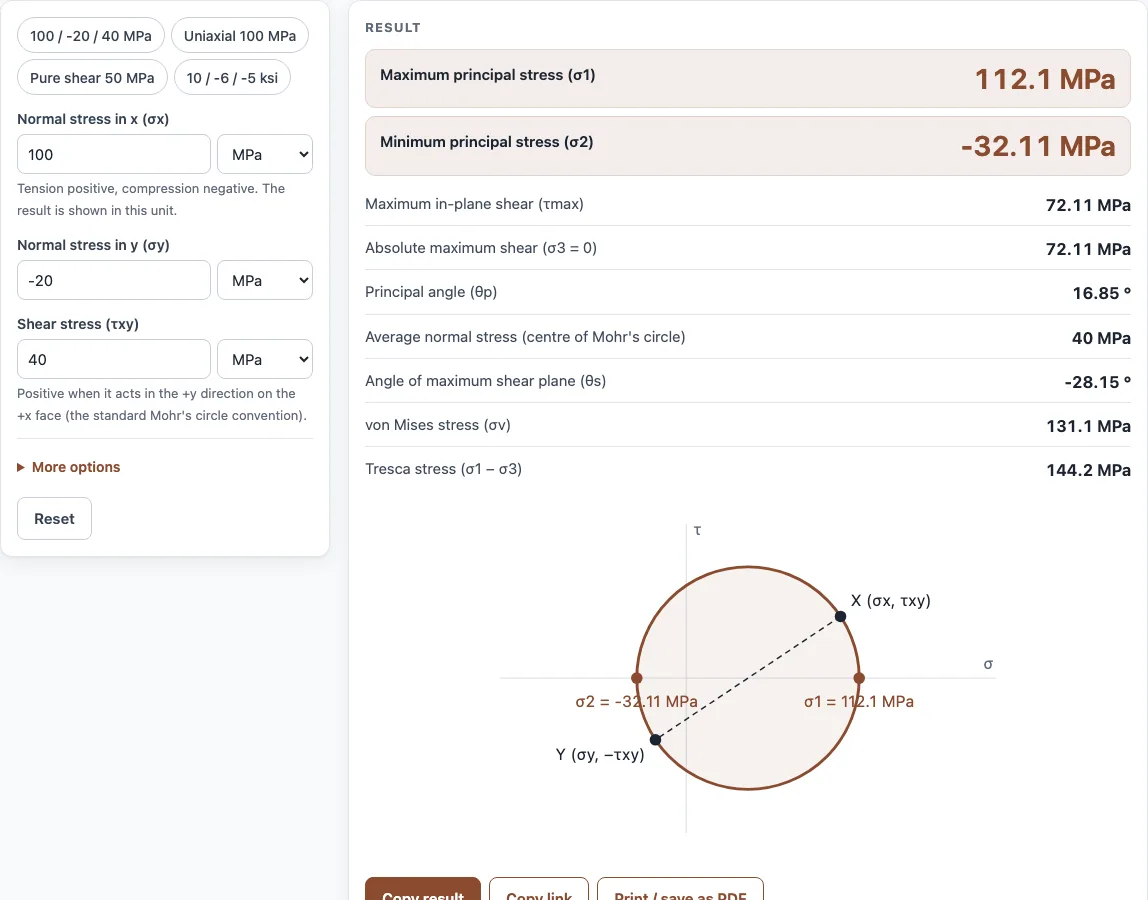
Also shown: the absolute maximum shear with σ3 = 0, the angle of the maximum shear plane, the von Mises and Tresca stresses, and a Mohr’s circle drawing with the x and y faces marked. The presets cover a biaxial case, uniaxial tension, pure shear and a ksi example.
What is the principal stress formula?
The principal stresses are the normal stresses on the planes where shear stress is zero. For a plane stress state with normal stresses σx and σy and shear stress τxy, they are:
σ1,2 = (σx + σy)/2 ± √(((σx − σy)/2)² + τxy²)
The term (σx + σy)/2 is the average normal stress, which is the centre of Mohr’s circle. The square-root term is the radius of the circle. The “+” value is the larger principal stress σ1 and the “−” value is σ2.
The same radius gives the maximum in-plane shear stress: τmax = √(((σx − σy)/2)² + τxy²). Shear on any plane is largest at 45° from the principal planes.
How do you find principal stresses?
Follow these steps:
- Find the average stress: (σx + σy)/2.
- Find half the difference: (σx − σy)/2.
- Find the radius: √(((σx − σy)/2)² + τxy²).
- Add and subtract the radius from the average to get σ1 and σ2.
Worked example with σx = 100 MPa, σy = −20 MPa and τxy = 40 MPa:
- Average = (100 − 20)/2 = 40 MPa
- Radius = √(60² + 40²) = √5200 ≈ 72.1 MPa
- σ1 = 40 + 72.1 = 112.1 MPa
- σ2 = 40 − 72.1 = −32.1 MPa
Check your signs. A negative σy or τxy changes the result, and a mistake in one sign will move both principal stresses.
How is von Mises stress used with principal stresses?
Von Mises stress combines σ1 and σ2 into one value to compare with a material’s yield strength: σv = √(σ1² − σ1σ2 + σ2²) in plane stress. For σ1 = 112.1 MPa and σ2 = −32.1 MPa it is about 131 MPa. Tresca uses the largest of |σ1|, |σ2| and |σ1 − σ2| instead and is slightly more conservative.
On a plane at any angle θ, the tool also gives the normal and shear stress by the transformation equations, so you can check the stress on a weld line or a fibre direction.
Sources
Checked October 2026:
- Wikipedia, Mohr’s circle for the principal stresses, maximum in-plane shear and principal angle; von Mises and Tresca criteria for plane stress from Hibbeler, Mechanics of Materials
For estimation; verify critical designs against the applicable standard.
Worked examples
| Input | Result |
|---|---|
| σx = 100 MPa, σy = -20 MPa, τxy = 40 MPa | σ1 = 112.1 MPa, σ2 = -32.11 MPa, τmax = 72.11 MPa, θp = 16.85° |
| σx = 100 MPa, σy = 0 MPa, τxy = 0 MPa | σ1 = 100 MPa, σ2 = 0 MPa, τmax = 50 MPa, θp = 0° |
| σx = 0 MPa, σy = 0 MPa, τxy = 50 MPa | σ1 = 50 MPa, σ2 = -50 MPa, τmax = 50 MPa, θp = 45° |
| σx = 10 ksi, σy = -6 ksi, τxy = -5 ksi | σ1 = 11.43 ksi, σ2 = -7.434 ksi, τmax = 9.434 ksi, θp = -16° |
Calculated by the tool above with these values.
Frequently asked questions
How do you draw Mohr’s circle?
Draw a horizontal axis for normal stress and a vertical axis for shear stress. Plot the x face at (σx, τxy) and the y face at (σy, −τxy), then draw a circle through those two points. The centre sits on the normal stress axis at (σx + σy)/2, and the radius is τmax.
What is the maximum shear stress?
In-plane, the maximum shear stress equals the circle radius, τmax = √(((σx − σy)/2)² + τxy²). For absolute maximum shear with σ3 = 0 (plane stress), use max(|σ1|, |σ2|, |σ1 − σ2|) ÷ 2. This value is larger than the in-plane maximum when σ1 and σ2 have the same sign.
How do you calculate von Mises stress from principal stresses?
Use σv = √(σ1² − σ1σ2 + σ2²). For the worked example above, with σ1 = 112.1 MPa and σ2 = −32.1 MPa, σv is about 131 MPa. The Tresca criterion uses max(|σ1|, |σ2|, |σ1 − σ2|) instead.
What is the principal angle?
The principal angle is θp = ½ atan2(2τxy, σx − σy), measured counter-clockwise from the x axis. It gives the direction of the plane that carries σ1. The plane for σ2 is 90° away, and the planes of maximum shear are 45° from the principal planes.
What is the principal angle for pure shear?
For σx = 0, σy = 0 and τxy = 50 MPa, the principal stresses are ±50 MPa and the principal angle is 45°. The maximum in-plane shear is also 50 MPa, the same size as the principal stresses, because the average stress is zero.
Can I use the results in reports or quotes?
Yes. Results may be used in commercial work such as quotes, customer calculations, shop paperwork and reports, without attribution.
Related tools
- Stress calculator: use it for direct stress from force and area when you do not need principal values.
- Hoop stress calculator: use it to find circumferential stress in a pressurised cylinder or pipe.
- Factor of safety calculator: use it to compare a material’s strength with the stress you have calculated.
- Beam deflection calculator: use it to find how far a beam bends under load.
- Moment of inertia calculator: use it to get the section property needed for bending stress and beam calculations.
- All calculators: use it to browse every tool on the site.