Shear Moment Diagram Calculator
Add the loads on a simply supported, cantilever or overhanging beam to get the reactions and the shear force and bending moment diagrams.
The shear moment diagram calculator finds the shear force and bending moment at every point along a beam, then draws both as diagrams. You enter the support type, span and loads, and it works out the support reactions, the maximum shear and maximum bending moment, and where each one occurs.
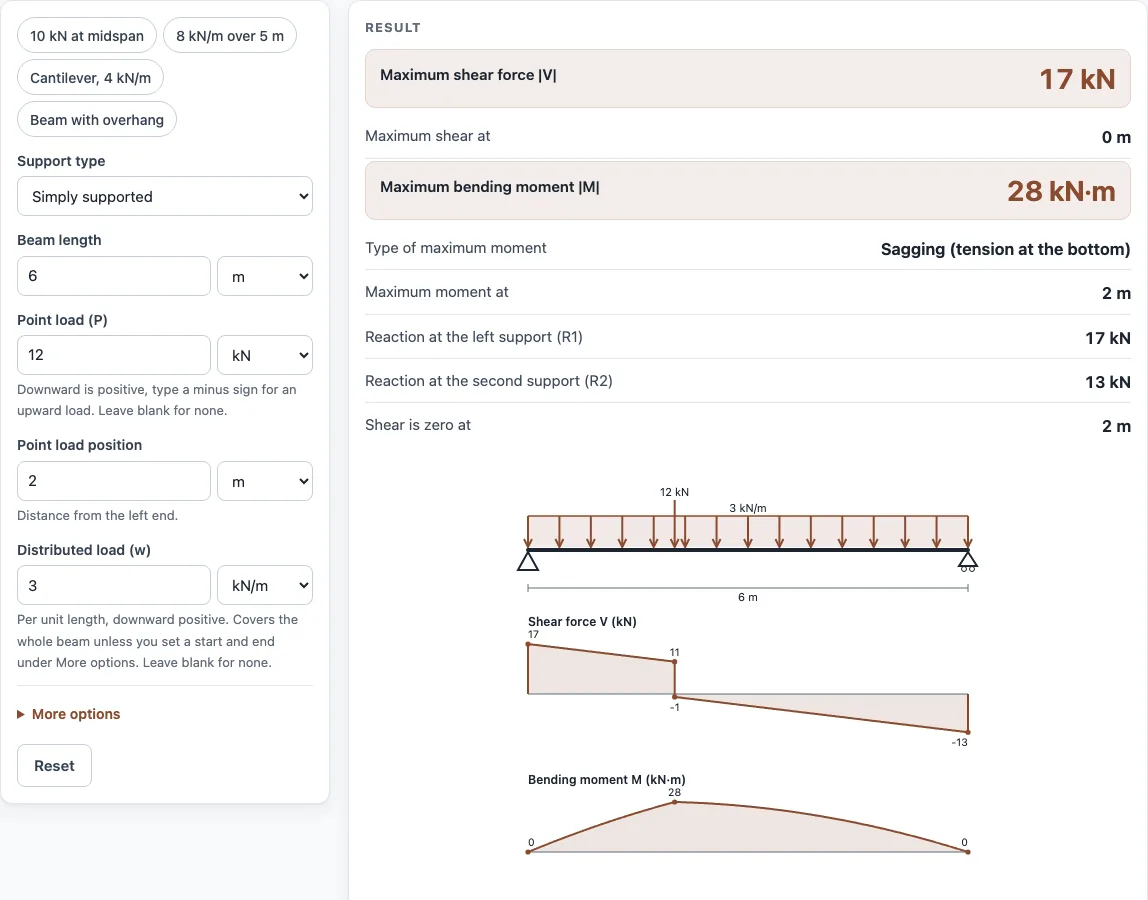
It draws three stacked views: the beam with its loads, the shear force diagram and the bending moment diagram, with values at the supports, load points and maximum. It handles simply supported beams, cantilevers and simply supported beams with an overhang, with point loads and distributed loads.
The tool runs in your browser. It is free, needs no sign-up, and works on a phone. You do not need the material’s modulus or the section’s moment of inertia, because shear and moment depend only on the loads, span and supports.
How to use the Shear moment diagram calculator
- Choose the support type: simply supported, cantilever fixed at the left end, or simply supported with an overhang.
- Enter the length of the beam. If you chose an overhang, enter the position of the second support.
- Enter the point load P and its position along the beam.
- Enter the distributed load w, with its start and end positions.
- For more loads, type one load per line in the “More loads” text box.
- Read the results. They update as you type. They include the reactions (and the fixed-end moment for a cantilever), the maximum shear and where it occurs, the maximum bending moment and where it occurs, the largest sagging and hogging moments, and the points where shear is zero.
- Check the three drawings and the table of V and M at the supports, load points and maximum. If a reaction is negative, a warning appears: the support would have to hold the beam down, so check your loads and support type.
- Open “How it was calculated” to see the formula and each step with your own numbers.
Copy result copies the result lines with a link. Copy link copies the page address, which stores every input (in the ?s= part of the address), so opening it later restores the same calculation. Print / save as PDF prints the inputs, results, calculation steps and the date, which is useful for quotes and shop paperwork.
How do you draw shear and moment diagrams?
Start by finding the support reactions from equilibrium: the sum of vertical forces is zero (ΣF = 0) and the sum of moments is zero (ΣM = 0). Then build the shear force diagram by adding up the vertical forces to the left of each section, and build the bending moment diagram by finding the area under the shear diagram.
Take a 4 m simply supported beam with a 10 kN downward load at 2 m. Taking moments about the left support gives a right reaction of 10 × 2 ÷ 4 = 5 kN, so the left reaction is also 5 kN. Just right of the left support, the shear is +5 kN. At the load it drops by 10 kN to −5 kN, and it returns to zero at the right support.
For the moment, the value starts at 0 at the left support and rises in a straight line with slope equal to the shear. At 2 m it reaches 5 × 2 = 10 kN·m. It then falls in a straight line back to 0 at the right support. Point loads cause jumps in the shear diagram equal to the load size, and distributed loads make the shear diagram slope at the rate of the load.
What is the relationship between shear and moment?
The bending moment is the integral of the shear: the slope of the moment diagram at any point equals the shear at that point. Put simply, the change in moment between two points equals the area under the shear diagram between them. This is why the moment peaks where the shear changes from positive to negative, passing through zero.
The sign convention matters when you read the diagrams. Sagging moment, where the beam curves up like a smile, is positive. Hogging moment, such as over the support of an overhang or at a cantilever’s fixed end, is negative. The calculator reports the largest sagging and hogging moments separately, so you can see both.
Sources
Checked October 2026:
- Closed-form beam cases (PL³/48EI, 5wL⁴/384EI, PL³/3EI, wL⁴/8EI) from AWC Design Aid No. 6, Beam Design Formulas with Shear and Moment Diagrams, and Roark’s Formulas for Stress and Strain
For estimation; verify critical designs against the applicable standard.
Worked examples
| Input | Result |
|---|---|
| Simply supported, 6 m: 12 kN down at 2 m, 3 kN/m down from 0 m to 6 m | maximum shear 17 kN, maximum moment 28 kN·m at 2 m |
| Simply supported, 4 m: 10 kN down at 2 m | maximum shear 5 kN, maximum moment 10 kN·m at 2 m |
| Cantilever (fixed at the left end), 2 m: 4 kN/m down from 0 m to 2 m | maximum shear 8 kN, maximum moment 8 kN·m at 0 m |
| Simply supported, 20 ft: 2 kip down at 8 ft, 300 lbf/ft down from 0 ft to 20 ft | maximum shear 4.2 kip, maximum moment 24 kip·ft at 8 ft |
| Simply supported with an overhang, 6 m: 5 kN down at 6 m, 2 kN/m down from 0 m to 6 m | maximum shear 8 kN, maximum moment 9.75 kN·m at 4.5 m |
Calculated by the tool above with these values.
Frequently asked questions
How do you find the maximum bending moment?
Find where the shear is zero, or where it changes sign. Then find the moment at that point by adding the moments of the forces on one side of it, or by taking the area under the shear diagram from an end. The largest moment in absolute value is the maximum.
Where is the bending moment maximum?
The bending moment is largest where the shear passes through zero. For a point load, this is usually at the load position. For a cantilever, it is at the fixed end, where the moment is typically hogging.
What is the bending moment of a simply supported beam with a point load?
For a point load P at distance a from one support and b from the other, with span L, the maximum moment is M = Pab ÷ L, at the load. If the load is at midspan, this reduces to M = PL ÷ 4. For example, a 10 kN load at 2 m on a 4 m span gives 10 kN·m.
Does the calculator need the beam’s E or I?
No. Shear and bending moment depend only on the loads, span and supports. You need E and I only for deflection, which is covered by the beam deflection calculator.
What does a negative reaction mean?
A negative reaction means the support would have to pull the beam down to stay in equilibrium. A simple support cannot do that, so the beam would lift off. Check the loads and the support type before using the results.
Which sign is the bending moment?
Sagging moments, where the beam curves up, are positive. Hogging moments, where the beam curves down, are negative. Over an overhang support or at a cantilever’s fixed end, the moment is hogging.
Related tools
- Beam deflection calculator: use it to find how far a beam bends under its loads, once you know its material and section.
- Beam load calculator: use it to work out the loads a beam must carry before you check shear and moment.
- Moment of inertia calculator: use it to find the section property needed for stress and deflection checks.
- Truss calculator: use it to find member forces in a truss, rather than in a single beam.
- Stress calculator: use it to turn a bending moment into bending stress in a section.
- All calculators: use it to browse every calculator on the site.