Spring Rate Calculator
Enter the wire diameter, outside diameter, coils and material to get the spring rate, and the load, deflection or stress for a given compression.
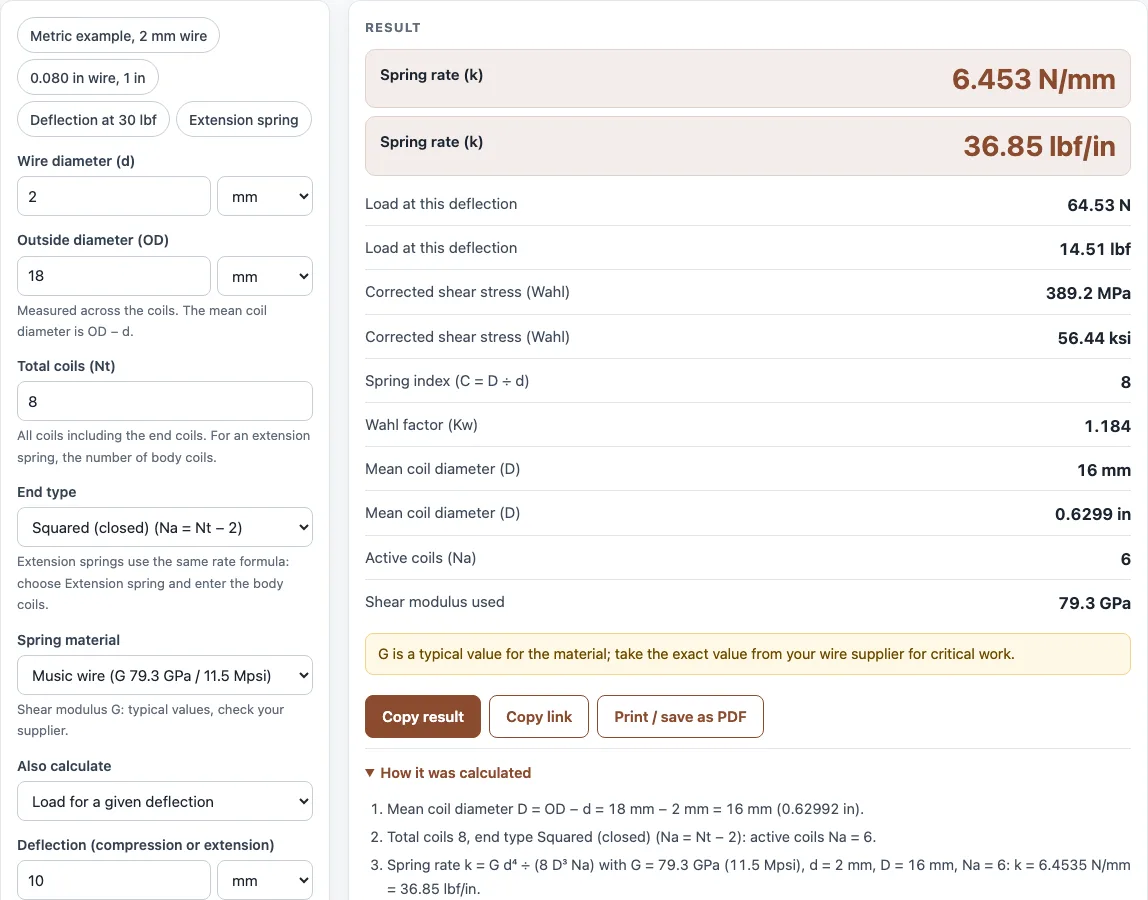
How to use the Spring Rate Calculator
- Choose the spring type: compression or extension.
- For a compression spring, pick the end type: plain, plain and ground, squared/closed, or squared and ground. The tool uses this choice to find the active coils. For an extension spring, enter the body coils and, if you have one, the initial tension F₀.
- Enter the wire diameter, d.
- Enter the outside diameter, OD. The tool finds the mean coil diameter, D = OD − d.
- Enter the total number of coils, Nt.
- Pick a material: music wire, oil-tempered / chrome-vanadium / chrome-silicon, or stainless 302/304/316. To use your own value, enter your shear modulus, G.
- If you need a load or a deflection, enter the deflection to get the load, or the load to get the deflection.
- Read the results: spring rate, load or deflection, corrected shear stress, spring index, Wahl factor, mean diameter, and active coils. Check any warning about the spring index.
- Open “How it was calculated” to see the formula with your numbers in it.
Results update as you type, so you can change one input and watch the rate move. Copy result copies the result lines with a link. Copy link copies the page address, which stores every input in the address (?s=…), so opening it later restores the same calculation. Print / save as PDF prints the inputs, results, calculation steps, and the date.
How do you calculate spring rate?
Spring rate is the force needed to compress or stretch a spring by one unit of length. A rate of 6.59 N/mm means each extra millimetre of deflection takes 6.59 N more force. The rate depends on four things: the wire diameter, the mean coil diameter, the number of active coils, and the shear modulus of the material.
The wire diameter has the biggest effect. Because it is raised to the fourth power, a slightly thicker wire makes a spring much stiffer. The mean coil diameter works the other way, appearing cubed in the denominator, so a smaller coil makes the spring stiffer. More active coils make the spring softer.
To work it out by hand, follow these steps:
- Find the mean coil diameter: D = OD − d.
- Find the active coils, Na, from the end type.
- Look up the shear modulus, G, for the material.
- Put the values into the formula.
For example, take 2 mm music wire, an 18 mm outside diameter, and 8 squared coils. D = 18 − 2 = 16 mm, and Na = 8 − 2 = 6. Music wire of this size has G = 11.75 Mpsi (81,013 N/mm²), so the rate is 81,013 × 16 ÷ 196,608 ≈ 6.593 N/mm, or 37.65 lbf/in.
What is the spring rate formula?
For a compression spring, the rate is k = G d⁴ ÷ (8 D³ Na). Here k is the spring rate, G is the shear modulus, d is the wire diameter, D is the mean coil diameter, and Na is the number of active coils. The formula assumes a helical coil spring with a round wire.
Keep the units consistent. With G in N/mm² (MPa) and d and D in millimetres, k comes out in N/mm. With G in psi and d and D in inches, k comes out in lbf/in. The calculator does this conversion for you and shows both units.
The formula also gives the load and deflection through F = k × x, where F is the load and x is the deflection. Rearranged, x = F ÷ k. Once you know k, these two relationships give the force for any movement, or the movement for any force, as long as the spring stays within its working range.
Sources
Checked October 2026:
- Shigley’s Mechanical Engineering Design, helical compression and torsion springs: k = G d⁴ / (8 D³ Na), Wahl factor, Ki, k = E d⁴ / (10.8 D N) per turn, end-coil corrections and the 4 to 12 spring index range; AMES compression spring formulas
- Engineers Edge, spring materials modulus table (Spring Manufacturers Institute values) for G and E of spring wire
For estimation; verify critical designs against the applicable standard.
Worked examples
| Input | Result |
|---|---|
| Wire 2 mm, OD 18 mm, 8 coils, Squared (closed) (Na = Nt − 2), Music wire (G 80.0–82.7 GPa / 11.6–12.0 Mpsi by wire size) | rate 6.593 N/mm (37.65 lbf/in), load 65.93 N (14.82 lbf), stress 397.6 MPa |
| Wire 0.080 in, OD 0.720 in, 10 coils, Squared and ground (Na = Nt − 2), Music wire (G 80.0–82.7 GPa / 11.6–12.0 Mpsi by wire size) | rate 5.024 N/mm (28.69 lbf/in), load 127.6 N (28.69 lbf), stress 745.4 MPa |
| Wire 0.105 in, OD 1.000 in, 12 coils, Squared and ground (Na = Nt − 2), Oil-tempered, chrome-vanadium, chrome-silicon (G 77.2 GPa / 11.2 Mpsi) | rate 4.157 N/mm (23.74 lbf/in), load 133.4 N (30 lbf), stress 477.2 MPa |
| Wire 1.5 mm, OD 12 mm, 14 coils, Plain and ground (Na = Nt − 1), Stainless steel 302 / 304 / 316 (G 68.9 GPa / 10.0 Mpsi) | rate 2.899 N/mm (16.56 lbf/in) |
| Wire 1.2 mm, OD 10 mm, 30 coils, Extension spring (Na = body coils), Music wire (G 80.0–82.7 GPa / 11.6–12.0 Mpsi by wire size) | rate 1.036 N/mm (5.915 lbf/in), load 19.54 N (4.392 lbf), stress 304.6 MPa |
Calculated by the tool above with these values.
Frequently asked questions
How many active coils does a spring have?
Active coils are the coils that bend and carry the deflection. For plain ends, Na = Nt. For plain and ground ends, Na = Nt − 1. For squared/closed or squared and ground ends, Na = Nt − 2. For an extension spring, Na is the number of body coils.
How do you calculate the load on a compression spring?
Use F = k × x, where k is the spring rate and x is the deflection. To find the deflection for a given load, use x = F ÷ k. For the 2 mm example at 10 mm deflection, 6.593 N/mm × 10 mm = 65.93 N, or 14.82 lbf.
What is the Wahl correction factor?
The Wahl factor, Kw, corrects the shear stress for the curvature of the wire and for direct shear. It is Kw = (4C − 1)/(4C − 4) + 0.615/C, where C = D ÷ d is the spring index. The corrected shear stress is τ = Kw × 8FD ÷ (πd³). For the 2 mm example, C = 8 and Kw ≈ 1.18, giving 397.6 MPa at 65.93 N.
Does this work for extension springs?
Yes. Select extension spring as the type, and Na is taken as the body coils. You can also enter an initial tension, F₀. For example, 1.2 mm music wire with a 10 mm outside diameter and 30 coils gives 1.005 N/mm, or 5.741 lbf/in. Hook stresses are not included, so check the hooks separately.
What does the spring index warning mean?
The spring index, C = D ÷ d, compares coil diameter with wire thickness. Below 4, the spring is hard to make and the stress is high. Above 12, the spring may tangle or buckle. The 0.080 in wire with a 0.720 in outside diameter has C = 8, which is within the normal range.
Can I use my own shear modulus?
Yes. Choose the option for your own G and enter the value. The listed values are typical values from the Spring Manufacturers Institute table: music wire 11.6 to 12.0 Mpsi (80.0 to 82.7 GPa), depending on wire size; oil-tempered, chrome-vanadium, and chrome-silicon 11.2 Mpsi (77.2 GPa); stainless 302, 304 and 316 10.0 Mpsi (68.9 GPa). For other materials, such as phosphor bronze, enter the value from your supplier. If your material data differs, use your own value.
Can I use the results in commercial work?
Yes. You can use the results in quotes, customer calculations, shop paperwork, and reports without attribution.
Related tools
- Torsion spring calculator: use it for garage door torsion springs, which store energy by twisting rather than compressing.
- Stress calculator: use it to check stresses in a part once you know the loads.
- Factor of safety calculator: use it to compare a spring’s working stress with the material’s strength.
- Bolt torque calculator: use it when you are setting the clamp force for a joint that includes a spring.
- All calculators: browse the full list of tools on this site.