Stress Calculator
Choose axial, shear, bending or torsion, enter the load and the section, and get the stress in MPa and psi with every step shown.
The stress calculator works out axial, direct shear, bending and torsional stress for a member from the force or moment applied and its cross-section. Results appear in MPa, psi and ksi, and if you enter Young’s modulus, the tool also gives strain. It runs in your browser, is free, and needs no sign-up. Use it to check a bar, beam or shaft quickly, or to prepare numbers for a quote or report. Results update as you type, so you can see how a change in size or load affects the stress straight away.
Each mode shows its formula with your numbers.
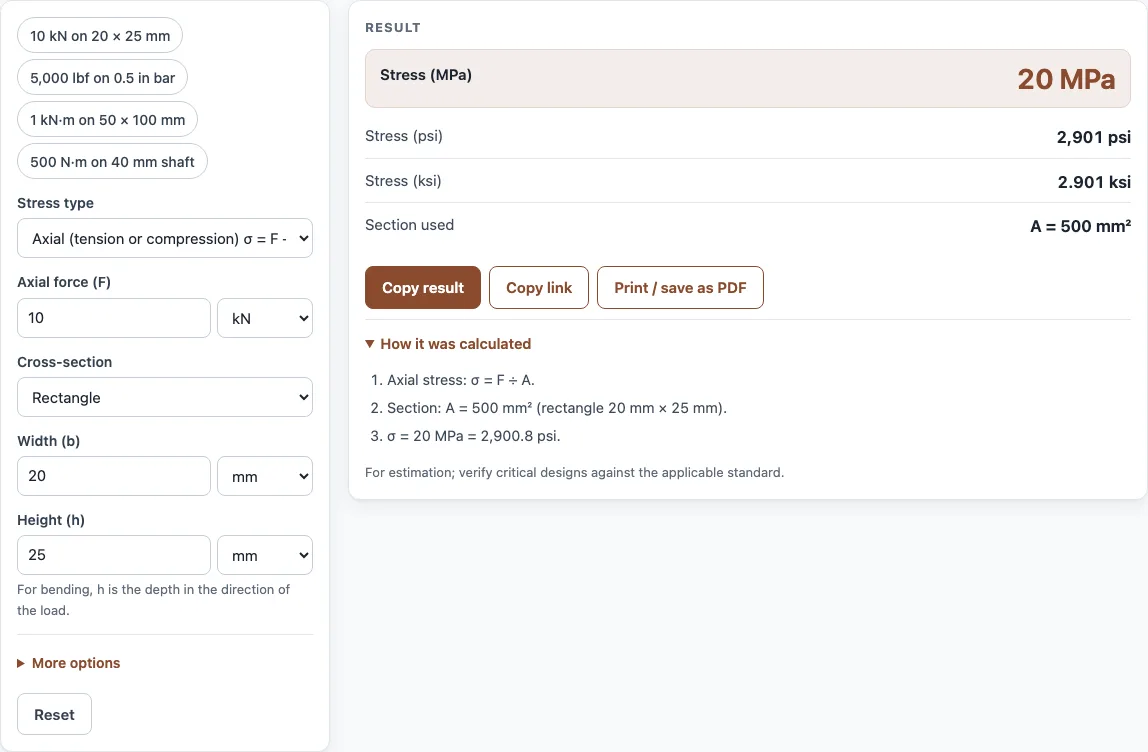
How to use the Stress Calculator
- Choose the stress type: axial (tension or compression), direct shear, bending, or torsional shear.
- Choose the cross-section: rectangle (b × h), round bar, round tube, or enter A, I and c, the section modulus S, or J and r directly.
- Enter the dimensions in mm or in. For a rectangle, enter b and h. For a round bar, enter d. For a round tube, enter D and d.
- Enter the load: a force in kN or lbf for axial and shear stress, or a moment in kN·m, N·m or lbf·ft for bending and torsion.
- Enter Young’s modulus E if you want strain. Strain uses E, so for shear strain enter the shear modulus G instead.
- Read the stress in MPa, psi and ksi. If E is entered, read the strain and microstrain too.
- Open “How it was calculated” to see the formula and each step with your numbers.
Copy result copies the result lines with a link. Copy link copies the page address, which stores every input, so opening it later restores the same calculation. Print / save as PDF prints the inputs, results, calculation steps and the date.
The presets show axial, bending and torsion cases in metric and US units.
How do you calculate stress?
Stress is force per unit area, so divide the force by the area it acts over. For axial loads, σ = F ÷ A, and tension and compression use the same formula. One MPa equals 1 N/mm², which is about 145.04 psi.
What is the bending stress formula?
Bending stress is σ = M × c ÷ I, where M is the bending moment, c is the distance from the neutral axis to the outer fiber, and I is the second moment of area. The same result can be written as σ = M ÷ S, where S = I ÷ c is the section modulus. For a rectangle, I = b h³ ÷ 12 and c = h/2, so the stress is largest at the outer edges.
How do you calculate shear stress?
Direct shear stress is τ = V ÷ A, where V is the shear force and A is the area resisting it. Dividing the shear force by that area gives the average shear stress across the section. For example, a shear force of 8 kN over 392.7 mm² gives 20.37 MPa.
What is the torsional stress formula?
Torsional shear stress is τ = T × r ÷ J, where T is the torque, r is the distance from the center to the point of interest, and J is the polar second moment of area. For a round bar, J = π d⁴ ÷ 32, and the stress is largest at the surface, where r = d/2. For a round tube, J = π (D⁴ − d⁴) ÷ 32.
How do you calculate strain from stress?
Strain is ε = σ ÷ E, where E is Young’s modulus for the material. Strain has no units, so 0.001 means a 0.1% change in length. Multiply by 1,000,000 to express it as microstrain.
What is bearing stress?
Bearing stress is the compressive stress where one part presses on another, such as a pin in a hole. It is calculated as force divided by the projected contact area, which for a pin is its diameter times the plate thickness. The tool has no separate bearing mode, so enter the projected area as A and use the axial option; the result uses the same F ÷ A division.
Sources
Checked October 2026:
- σ = F/A, τ = V/A, σ = M c / I, τ = T r / J with J = π d⁴/32, and ε = σ/E (Hibbeler, Mechanics of Materials)
For estimation; verify critical designs against the applicable standard.
Worked examples
| Input | Result |
|---|---|
| F = 10 kN, A = 500 mm² | σ = 20 MPa (2,901 psi) |
| F = 5000 lbf, A = 0.19635 in² | σ = 175.6 MPa (25,460 psi) |
| V = 8 kN, A = 392.7 mm² | τ = 20.37 MPa (2,955 psi) |
| M = 1 kN·m, I = 4.1667 × 10⁶ mm⁴, c = 50 mm | σ = 12 MPa (1,740 psi) |
| M = 2000 lbf·ft, I = 0.7854 in⁴, c = 1 in | σ = 210.7 MPa (30,560 psi) |
| T = 500 N·m, J = 251,330 mm⁴, r = 20 mm | τ = 39.79 MPa (5,771 psi) |
Calculated by the tool above with these values.
Frequently asked questions
Can I mix units, such as kN and lbf, in one calculation?
Yes. You can enter a force in kN or lbf and dimensions in mm or in. Check the calculation steps to confirm the units converted as you expected.
Which stress type should I choose?
Choose axial for a force pulling or pushing along the length of a member. Choose direct shear for a force that slides one part across another, bending for a moment that makes a beam bend, and torsional shear for a twisting torque.
What does a strain warning above 1% mean?
Strain above 1% means the stress is probably beyond the elastic range. In that case, ε = σ ÷ E no longer describes the part well, so check the load and the material before you rely on the result.
Can I use the results in commercial work?
Yes. Results may be used in quotes, customer calculations, shop paperwork and reports without attribution. Check the inputs and steps before you rely on a result for a safety-critical decision.
Does the tool work on a phone?
Yes. The calculator runs in the browser and works on a phone. Nothing you enter is uploaded.
What is the compressive stress formula?
It is the same as for tension: σ = F ÷ A. Long, slender members in compression can buckle before they reach that stress; check them with the column buckling calculator.
Related tools
- Principal stress calculator: use it when you need the maximum and minimum normal stresses on a plane under combined loading.
- Factor of safety calculator: use it to compare a calculated stress with a material strength.
- Moment of inertia calculator: use it to find I or J for a cross-section before you calculate bending or torsional stress.
- Beam load calculator: use it to find the bending moment and shear force on a beam before you enter them here.
- Hoop stress calculator: use it for stress in the wall of a pipe or pressure vessel.
- All calculators: use it to browse every calculator on the site.