Garage Door Spring Calculator (Torsion Spring)
Work out the torque per turn of a torsion spring and compare it with what your door's weight, height and drum size need.
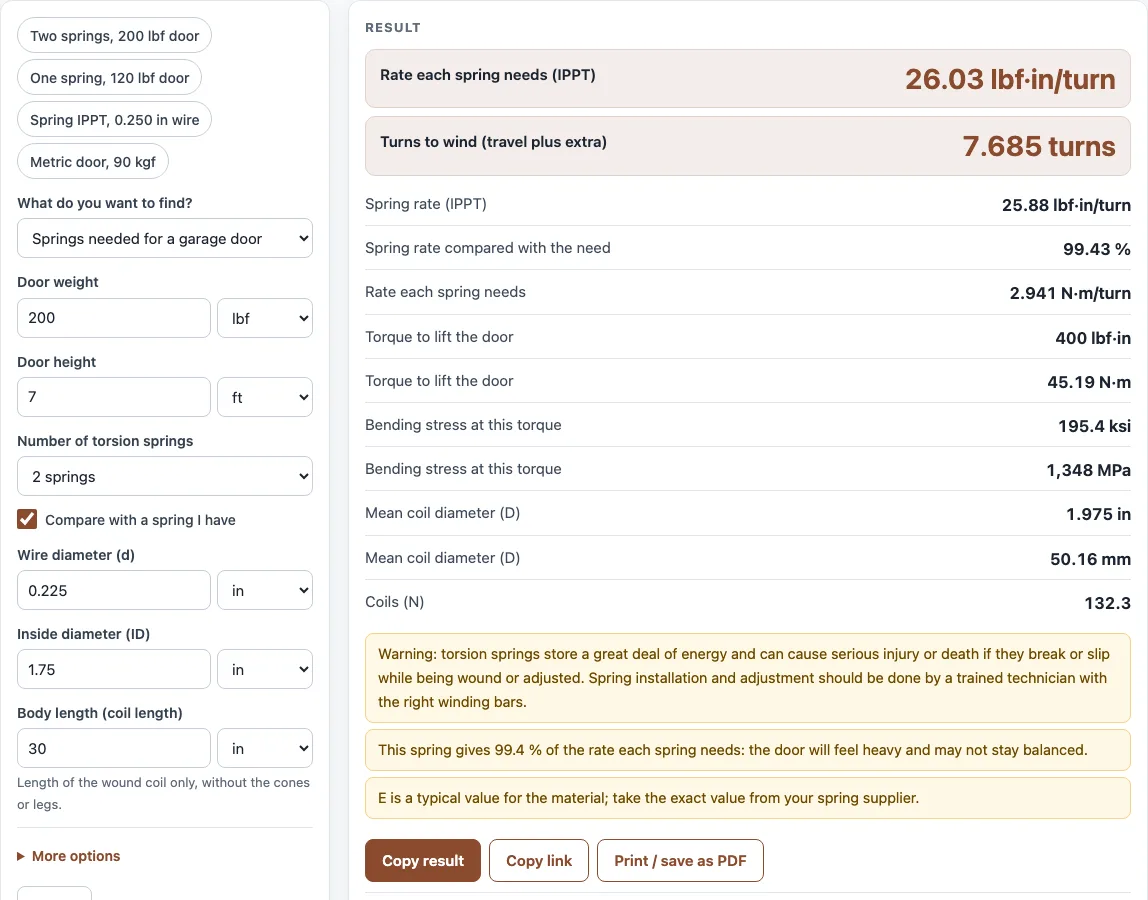
How to use the Torsion Spring Calculator
- Choose the door mode, which finds the springs needed for a garage door.
- Enter the door weight, using the unit shown on the field.
- Enter the door height.
- Enter the cable drum diameter. It defaults to 4 in, so change it if your drums differ.
- Select 1 or 2 springs.
- Check the extra turns setting, which defaults to 1.
- Read the results: turns to wind, torque to lift the door, and the required IPPT per spring.
- Optionally, enter a spring you already have. The result shows its rate as a percent of what each spring needs, with a warning if it is weaker or stronger.
- Open “How it was calculated” to see the formula and each step with your numbers.
Copy result copies the result lines with a link. Copy link copies the page address, which stores every input, so opening it later restores the same calculation. Print / save as PDF prints the inputs, results, calculation steps and the date.
The same steps work as an overhead door spring calculator for any sectional door with torsion springs on a shaft. The presets show two springs on a 200 lbf door, one spring on a 120 lbf door, a spring rate example and a metric door.
How do I calculate the garage door spring size I need?
Spring size for a garage door is set by two numbers: the turns the spring must be wound and the torque it must deliver per turn. The tool finds both from the door weight, door height and drum size, then divides the torque across the springs you choose.
First, the turns to wind equal the door height divided by the drum’s circumference (π × drum diameter), plus the extra turns. Second, the torque to lift the door equals the door weight times the drum radius. Third, the rate each spring needs equals that torque divided by the turns and by the number of springs.
For a 200 lbf door, 7 ft high, on 4 in drums with two springs: 7 ft is 84 in, and 84 ÷ (π × 4) = 6.685, plus 1 extra turn gives 7.685 turns. The torque is 200 × 2 = 400 lbf·in. Then 400 ÷ 7.685 ÷ 2 = 26.0 IPPT per spring.
What does IPPT mean?
IPPT stands for inch-pounds per turn. It is the torque a torsion spring delivers for each turn of winding, measured in inch-pounds (lbf·in). A higher IPPT means a stiffer spring that lifts more weight for the same number of turns.
The tool also shows the same value in N·m per turn. For a 120 lbf door, 7 ft high, on 4 in drums with one spring, the spring needs 31.2 IPPT. If the spring you have gives 82.9% of that figure, it is weaker than needed.
Sources
Checked October 2026:
- Shigley’s Mechanical Engineering Design, helical compression and torsion springs: k = G d⁴ / (8 D³ Na), Wahl factor, Ki, k = E d⁴ / (10.8 D N) per turn, end-coil corrections and the 4 to 12 spring index range; AMES compression spring formulas
- Engineers Edge, spring materials modulus table (Spring Manufacturers Institute values) for G and E of spring wire
- Garage door balance: lifting torque = door weight × drum radius and turns = door height ÷ drum circumference + extra turns (statics); torsion springs are dangerous and should be set by a trained technician
For estimation; verify critical designs against the applicable standard.
Worked examples
| Input | Result |
|---|---|
| 200 lbf door, 7 ft high, 4 in drum, 2 spring(s) | wind 7.685 turns, each spring 26.03 lbf·in/turn (IPPT); the spring entered gives 99.4 % of that |
| 120 lbf door, 7 ft high, 4 in drum, 1 spring(s) | wind 7.685 turns, each spring 31.23 lbf·in/turn (IPPT); the spring entered gives 82.9 % of that |
| 90 kgf door, 2.1 m high, 100 mm drum, 2 spring(s) | wind 7.685 turns, each spring 25.41 lbf·in/turn (IPPT) |
| Wire 0.250 in, ID 1.75 in, body length 30 in | rate 43.31 lbf·in/turn (4.894 N·m/turn); bending stress 71.88 ksi |
| Wire 6 mm, ID 44 mm, 100 coils | rate 41.01 lbf·in/turn (4.633 N·m/turn) |
Calculated by the tool above with these values.
Frequently asked questions
How many turns on a garage door torsion spring?
The number of turns depends on the door height, drum diameter and extra turns. The calculator gives the turns to wind as height ÷ (π × drum diameter) + extra turns. A 7 ft door on 4 in drums needs 7.685 turns with the default one extra turn.
How do you calculate torsion spring rate?
Torsion spring rate (torque per turn) equals E × d⁴ ÷ (10.8 × D × N). Here E is Young’s modulus, d is wire diameter, D is mean diameter (inside diameter plus wire diameter), and N is the number of coils. For a 0.250 in wire, 1.75 in inside diameter and 30 in long oil-tempered spring, the rate is 43.3 IPPT.
Should I use one or two springs?
Two springs share the lifting torque, so each one needs half the IPPT of a single spring lifting the same door. A 200 lbf door on 4 in drums with two springs needs 26.0 IPPT per spring. Run the calculator with both settings, then check which setup your door uses and the spring chart for your drum size.
Is it safe to replace garage door springs myself?
Torsion springs store a large amount of energy and can cause serious injury. The tool shows this warning first for that reason. Winding, unwinding and replacing torsion springs should be left to a trained technician who uses winding bars.
Are the results exact?
The results are estimates. Door hardware makers publish spring charts for their own drums and doors, and those charts should be used to confirm a choice before you buy or install a spring.
Can I use the results in a quote or report?
Yes. Results may be used in commercial work, such as quotes, customer calculations, shop paperwork and reports, without attribution.
Related tools
- Spring rate calculator: use it to find the rate of other spring types when you are not working with a torsion spring.
- Stress calculator: use it to check the stress in a part or spring under a known load.
- Factor of safety calculator: use it to compare a design’s working stress with its strength.
- All calculators: use it to browse every tool on the site.